Showing posts with label spirituality. Show all posts

Tuesday, December 14, 2010

Zen Beginnings

Someone asked on my alumni email list why we changed religions, specifically naming me among others.  Why, and at what point in our life, we came to Buddhism, etc.


First, I said,  Such a big question! So much to say...I guess I'll do the zen thing and boil it down to the essence....


St. John's is directly responsible.

Then, I sent another post:

that is to say...
When I came to St. John's it slowly dawned on me that I had difficulty interacting with the books and in seminar because I did not know myself. A momentous realization occurred during, or I should say after, the Symposium seminar, when quite a few of us piled into cars and the back of a pickup and went to Spike Venable's house to continue the party. (All Spike had left in the house was some sherry, which we eagerly drank because it was booze of some kind.)

Certain moments at that party blend together as the moment when I realized. Mr. Cornell saying "Ms. Hoog... is drunk! Ms. Hoog... is drunk!" and me thinking 'yeah so are you!' and me responding to something somebody asked by saying, "I don't know what I believe!" realizing that at that moment I could no longer call myself a Christian and two friends of Spike's, not Johnnies, who insisted it was possible to be Buddhist *and* Christian. I had no idea what Buddhism was, and if they explained, I was too drunk to retain it.

But I was beginning to uncover myself. I was busy imbibing Great Books, often reading them twice but still not knowing what to say.

Along about the time we were reading the Bible, my boss in the library, Jon Schaefer, [son of Jack Schaefer] would talk with much enthusiasm about his Buddhist beliefs and about his experiences meditating with Some Great American Convert I don't remember who, who so steadfastly meditated in the snow, etc. I was intrigued, but didn't know what about, really. Some unremembered amount of time later, I was in the bookstore buying up some needed Great Books, when I paused at the Eastern Philosophies/Religions bookshelf, vaguely remembering Jon's enthusiasms.

George Wen... noticed my pause and asked if I was wondering what to start with. I supposed I was. So on his recommendation I bought Zen Mind Beginner's Mind and Three Pillars of Zen. The first I began to read and was hooked. Yes! Yes! Yes! It felt like coming home. The second I used for the illustrations and instructions on how to meditate, but didn't much read because I didn't want to read about answers before I had a chance to experience, having got the message from ZMBM that this was very much an experiential religion.

I tried meditating, but it felt weird, so I gave it up. Long about the time I was able to choose my first preceptorial, and got into "Ancient Chinese Philosophy" with Ralph Swentzell, I thought it might be a good time to try meditating again, and Jon was starting up a pre-seminar meditation period. Never mind that this was pre-Buddhist Chinese philosophy, I knew nothing about that.

So I started meditating, and this time it felt right. That first time, I felt like I was swirling down into a vortex. This time I felt like a Weight Lifted, and I felt ebullient. I have long felt fortunate for that early experience, as it kept me on the path. Buddhist faith asks that you give it a try, and you will eventually experience why it was worth giving a try. This early experience became a beacon when I might have drifted for the sameness of the meditation experience.

It seems to have been a blessing of my life... Blessing? Serendipity? Coincidence? That I chose to walk a path for perhaps the silliest of reasons, and the path I chose turned out to be so important. It's significant to me now that I didn't start meditating until I was ready. The St. John's way was working to help me make the unconscious conscious to the point where I could be ready for the more powerful uncovering of meditation. Being away from my dysfunctional home was helping me shed fear that was instrumental in creating the wall that kept me from knowing myself.

Later on I came to see the religion of my childhood was a pasted-on belief. Since I was a child when it was offered, and at times forced on me, it wasn't something I really had a choice about. I didn't really have much choice about knowing myself, either, as for my survival in a dysfunctional house it was best not to fully face the unfairness of it. Come to think of it, having come to a safe place during a time of exploration, it was probably inevitable that I would lose my religion, among other things.

That's the beginning.

Thursday, August 14, 2008

The Need for a Reason

Last month The Friendly Atheist started a great conversation on his blog about the saying It happened for a reason. I feel a bit as he does when I hear that. Usually I see a bit a lazy thinking when someone says that. If they looked really hard, they could find the true cause-effect reason, and the supernatural spiritual reason ends up looking a bit shallow. Buddhists are not immune to this, and this kind of thinking could be responsible for the degradation of the meaning of karma.

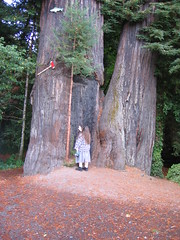
(completely random photo from my flickr pages, no wait it happened for a reason...)

Recently, after reading the book Taking Up Space, I had one of those inner conversations I talk about in my comment. In some parallel world (explained below), some Heidi didn't take up meditation, and she went through years of yo-yo dieting. Maybe she even underwent the awful gastric bypass surgery. In actuality, when I started meditating, I eventually could no longer diet because I could no longer ignore the signals from my body and my inner voice.

Here's what I said in the comments at The Friendly Atheist Blog:

great post.

I like wondering why people need this kind of belief. It fills a psychological need, what exactly I'm not sure. I think Darryl pointed toward it with the scene from Blade Runner. (I haven't seen it.) It responds to a fear of death, and a fear of inconsequence, I suppose.

When those special moments happen, I often think of parallel worlds, and that in some other parallel world some other Heidi did not start a meditation practice but instead became a sick drunk. Or some other Heidi really did swerve off the road into a deep ravine when Driving While too Emotional. Those close calls remind us of our mortality, and our victory over death seems to be a gift.

When those moments happen like a great parking spot happens, I like to say, "the cosmos is smiling on me." with a smile at myself for needing a little something more poetic than gratitude for mere coincidence.

I think psychologically there's a need to respond to something that feels bigger than this puny human existence. The simple way is to ascribe something happening for a reason so this existence can feel equal to the grand chaotic universe. Perhaps a more sophisticated way is to recognize the puniness and the grandness as equally important and that yes, my experience is the whole world, for me, and I am just a small part in the whole world.

I guess I am trying to flush out the psychological need for a spiritual existence. If I can understand, I can understand why people believe the things they do.

Friday, July 25, 2008

Books with a Spiritual Thread

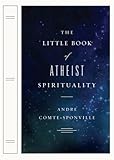
The Little Book of Atheist Spirituality
The Little Book of Atheist Spirituality by André Comte-Sponville
rating: 3 of 5 stars

I read some, skimmed some of this book. In some ways it reads like an overview of philosophy through the history of the Western Canon, as one of the prevalent themes of philosophy has been the attempt to posit the existence of God. It took me back to my college days, and reminded me of that all-consuming quest of the Liberal Arts student. Even science seeks the truth to the Root Cause of All Things.

If a reader doesn't have this literary background, it's possible the philosophical name-dropping of this book could be confusing and fatiguing, or it could ignite an interest in further study.

It has 4 sections: I. Can We Do Without Religion? II. Does God Exist? III. Can There Be an Atheist Spirituality? Conclusion: Love and Truth.

In short, to answer the first: yes. The second: all those philosophers could not prove the existence of God. Thus Pascal's Wager, and the author deals with that. The third: is answered by the conclusion.

That said, for those interested in this subject, the book is worth reading for that overview of the Western Canon on religion and God. In essence, the author is outlining how one could be an atheist, and still find a place in religion for spiritual connection.

This summary on why he does not believe in God is quite useful:

1. The weakness of the opposing arguments, the so-called proofs of God's existence.
2. Common experience: If God existed, he should be easier to see or sense.
3. My refusal to explain something I cannot understand by something I understand even less.
4. The enormity of evil.
5. The mediocrity of mankind.
6. Last but not least, the fact that God corresponds so perfectly to our wishes that there is every reason to think he was invented to fulfill them, at least in fantasy; this makes religion an illusion in the Freudian sense of the term.
In the end, he has some intriguing thoughts and quotes on mysticism, and how it is not mutually exclusive with atheism.

"The prophet receives and transmits the word of God to which he adheres through faith; the mystic is sensitive to an inner light that exempts him from believing. The two are incompatible." ~French Jesuit Henri-Marie Cardinal de Lubac

"I am a mystic and believe in nothing." ~Nietzsche

The author did touch on Buddhism and Taoism at times as quite compatible with his thinking. Sometimes it was frustrating to me that he argued with Western thought when I thought Buddhist thought would have met those arguments easily.


Enso: Zen Circles of Enlightenment Enso: Zen Circles of Enlightenment by Audrey Yoshiko Seo
rating: 4 of 5 stars

The Buddhist name my Zen teacher gave me is Enji, which contains the same character as Enso, the word for this circle that symbolizes Zen for many, so of course I had to pick up this book. In the introduction we learn that early Indian culture is credited with the development of zero as we use it in mathematics.


Not only does the book share various historic versions of the Enso and explain this particular tradition in calligraphy, it is a window into a small section of the history of Zen itself.

The author says "Torei Enji is considered by many to be the King of enso." I think he may be my namesake, but can't be sure as I don't know the kanji. When you see these circles, you may think they're not perfect...but according to the book, they meant to do that. I don't know, there was at least one where I thought the verse was attached to joke about the unintended mistake.

Enso pictures were often accompanied with traditional verses, or verses coined by the Zen master. Torei Enji (1721-1792) often used the verse from the mythic words of the Buddha upon his birth, "In Heaven and the Earth below I alone am the Honored One."

The verse I like describes the enso and my name comes from the Third Patriarch Chien-Chih Sen Ts'an, "Precepts of the True Heart": Round and perfect like vast space, nothing lacking, nothing in excess.

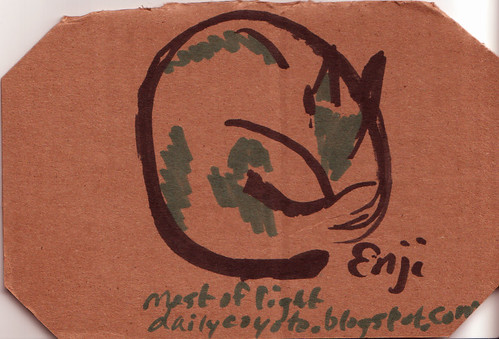
Often the artists would incorporate pictures with the round circle, often making the picture dark and the circle a lighter grey. I was inspired to make a habit of drawing the enso myself. Here is one of my first efforts. I should mention I used a marker brush.

enso fox 07 2008

View all my reviews.