Showing posts with label writing. Show all posts

Sunday, December 23, 2012

Another Writing Venue

I am still working on the Psyche and Eros series. I got bogged down with wanting to write about things not appropriate for an any age audience, so I started another blog behind an over-18 wall. I am happy to say I am still writing and eager to write.

More is coming here soon. That and the holidays have taken up my time, as well as my adventures in dating.

If you want to get on a private email list for the content of the new blog, send me a private message.  I write there about the same sorts of things as I do here, but the focus and the content is generally suitable for adults only.  Only ask if you are comfortable with reading the intimate details, well-written, if feedback so far is to be believed.

It is titled Soft Animal Body. The inspiration comes from Mary Oliver's poem Wild Geese. This pretty much sums up the theme.

You do not have to be good. 
You do not have to walk on your knees 
For a hundred miles through the desert, repenting. 
You only have to let the soft animal of your body love what it loves. 
Tell me about your despair, yours, and I will tell you mine. 
Meanwhile the world goes on. 


Thursday, October 18, 2012

How to Live: Or A Life of Montaigne...

How to Live: Or A Life of Montaigne in One Question and Twenty Attempts at an Answer My book group read How to Live: Or A Life of Montaigne in One Question and Twenty Attempts at an Answer in September.  That's a mouthful.  These convoluted titles seem to be a trend lately.  Don't let that stop you from checking out this book. Almost all of the book groupees loved this book, though some were hesitant to begin.

This was one of my subversive picks.  Since I am the one who tallies the votes for our year's picks, I get to target my votes.  I made sure this one made the cut.  I needed to have a reason to read this book, and sometimes, no matter how much I want to read a book, I won't get around to it unless duty calls...so I made sure duty called. Several of my co-conspirators in book group facilitation do the same thing.  And as I suspected, I loved it.  And I fell in love with Montaigne.  As I said in the book group, I am so jealous that I never get to meet Montaigne, that I can't travel back to his time.

This book also made me feel like I could begin blogging again.  How to live?  That is indeed the question of my life, right next to 'What does this mean, to be alive?'  Along with getting a taste of Montaigne and a peek at his life, we get the view of Montaigne down through history.  Individuals brought him forward into their age and found their own reflections in his essays.  There are the Stoics and the Romantics...everybody finds something in Montaigne. Pascal and Descartes hated him (as he anticipated and decimated their arguments).  Regarding thes two, some of what Sarah Bakewell says is this:

Descartes cannot truly exchange a glance with an animal. Montaigne can, and does. In one famous passage, he mused: “When I play with my cat, who knows if I am not a pastime to her more than she is to me?” And he added in another version of the text: “We entertain each other with reciprocal monkey tricks. If I have my time to begin or to refuse, so has she hers.” He borrows his cat’s point of view in relation to him just as readily as he occupies his own in relation to her.
This comfortable acceptance of life as it is, and of one’s own self as it is, drove Pascal to a greater fury than Pyrrhonian Skepticism itself. The two go together. Montaigne places everything in doubt, but then he deliberately reaffirms everything that is familiar, uncertain, and ordinary—for that is all we have. His Skepticism makes him celebrate imperfection: the very thing Pascal, as much as Descartes, wanted to escape but never could.

Montaigne was the first to write the essay, and now, in this world of personal blogs, we live his legacy.  He wrote like we do, in stream of consciousness, about anything he encountered and pondered in his life.  Unlike blogging, where we may never revisit our blatherings, Montaigne goes back, and inserts new thoughts into old essays, often, according to Bakewell, not bothering to make his difference in age make sense.  Some editions of Montaigne indicate different timelines with A, B, and C.  Of course, we do link back to our past lives in essays.

Montaigne is a man of my own heart.  He resolved to pay attention, and did so in his essays.  Of all the vows I have made through the years, this is my top pick.  I trust in paying attention.  All the while I was not blogging, at least I was paying attention.  Whatever I noticed may have slipped through the sieve of my brain...sometimes if writing is anything it is to catch the sand of thoughts before the grains slip through the holes...but I was waiting with my attention for something to give me a reason for my frozen state.

I hoped this book could inspire people to read Montaigne.  It certainly did me, and I hope to read Montaigne and find my reflection in him, as so many others have before me.  I've tried a slow read of hefty non-fiction tomes before.  I fizzled out with A People's History.  So, I only say, "I hope."  I only know my way in to blogging feels kinda broken, and perhaps I need a mentor of sorts, like Montaigne.  It won't just be a reading of a text, but it will be the query, "How to live?"  As I've mentioned, I don't seem to be able to stick to a plan unless I have an externally imposed deadline, so I'm making no plan.  Maybe I'll visit Montaigne once a week and reflect...maybe once a month, but I do know I look forward to meeting his mind.


Sunday, October 14, 2012

Ripening

How does one resurrect a dead blog? In 2010 and 2011 I tried with a few fizzles.  I consciously knew of some reasons. This has never been simply a book blog, but it was devolving into one.  My sweetie is never quite as comfortable as I am talking about certain things, and I was feeling hesitant about some topics for his sake. Whenever I come up with a plan, as I attempted to, I invariably lose some kind of impetus.  Is that self-sabotage?  Or is that feeling the loss of the energy of spontaneity?  I know I do well with the duty of deadlines, but I can never seem to trick myself into imposing them on myself.  In some ways, I didn't feel like I had much interesting to say.
IMG_0064 copy
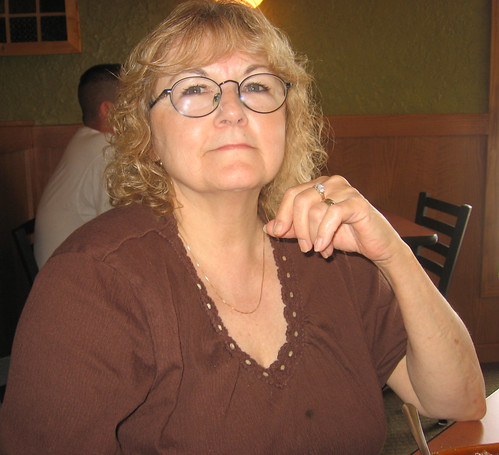
My mom, July 2007
More recently, though I felt the wish to write, and have had quite a few hefty topics I wished to write about, I'd think about it for a day and then never get around to it.  I was only interested in reading.  Reading became an obsession.  I was consciously aware I turned to predictable pap after my mom died.  Yes, my mom died and I couldn't bring myself to write about it here.  It was partly because I didn't know what to say, and partly because I didn't want to bring this thing back to life with a death. I knew I needed to grieve, but reading was a way to take a break.

Until it tilted over into my default activity.  If I didn't have anything else to do, and even if I did, I read.  I keep an eye out for free kindle books, but I buy many as well.  So much so that when my kindle stopped working, Amazon replaced it for free even though it was past warranty.  I certainly became too sedentary.

Even more recently, when I shared this embarrassing obsession a person at the right time suggested perhaps depression is involved. Often when I mentioned it, people said well if I'm going to have an obsession, reading is a good one to have.  This is why I'm embarrassed...no...it's not good when it affects my health, and not when I can't set it aside.

Fortunately, it has been my pattern that once something is conscious and able to be Named, its days are numbered.  Even just the thought sequence, 'oh yeah, i'm depressed, that's why this is hard' has lessened the feeling of depression.

Patrick, ?2009
So then, I started adding up the reasons why I could be depressed. Several deaths: a few years back, my nephew, and in January this year, my mom.  She was just a few days shy of 70.  And I've confessed it before to individuals, and I'll confess it now for the world to see, well, he even said it himself, her husband was supposed to die first.  He's a jerk, and someone should have diagnosed him a sociopath at least 30 years ago.  Then this May, my friend Patrick died almost immediately after a cancer diagnosis.  Happily, I was able to help with hospice vigil, and go out to lunch one last time along with his brother, oh jeez, was his name Brian?

Also in there I lost another friend.  After nearly 20 years, she broke it off with me.  There was conflict, but nothing that couldn't have normally been dealt with and forgiven. There's no divorce when friendships end, but there is heartbreak.

I'm sure there are other things that contributed to the sink into depression, including the reading thing that at first was a comforting salve, along with the lack of activity.

I am not prone to depression, which is perhaps why I couldn't see it.  Perhaps I didn't want to see it, as well.  One other time in my life I was seriously depressed, heartbroken. The thing that helped me climb out? Some feisty no-strings sex, along with some happy dope.  Ahhh, endorphins and dopamine!  At that time, meditation did not help, but now, with this creeping malaise, I think it would.

For now, I am seeking those fun endorphins (wink wink).  It is already helping.  I've started keeping my Dharma School blog again, and here I am, excited to write again, feeling like I might have something interesting to say.  I feel the urge to take photos again.  I appreciate the friends I still have, and the deepening friendship of a couple in particular with whom I can talk about anything...I mean anything.  Perhaps soon I will be able to pick up that daily habit of meditation again.  Oh, and since I picked up those extra endorphins, I have actually put the kindle away for hours at a time!


Friday, July 10, 2009

The Starjumper Experiment

I've decided to take the plunge and begin an experiment in writing and the gift economy. My strengths include sticking to a deadline, and doing for others while I put off doing for myself. My weak points include procrastination and fuzzy goals. It may be a spiritual strength to live in the present, but that's not so strong for setting goals. It may be a spiritual strength to lack megalomania, but as one writer told me, a little bit of that is needed in a writer. So, since I can't seem to impose deadlines on myself, I decided to seek pressure from others. Since I can focus intently and get the job done when I know others are counting on me, I decided to find my audience now, rather than after I've finished the never-ending novel.

Along for the ride is my thought for the future of creativity, that it could thrive from a basis of a gift economy. Many of us offer freely the products of our passion, and don't expect to make a living at it. With the ease of self-publishing, more people are writing, and with more people writing, they are getting better at it. For that matter, with the ease of digital photography, more people are taking more photos, so more people are getting better at it. It is going to be harder to stand out, harder to become a "star" as we once thought of them. It could be easier, however, to develop a loyal following.

Already, many published writers cannot make a living from the quality books they write and do get published. Many have day jobs. The same will be for photographers. Even if publishing persists, more and more, authors will be more likely to get deals if they already have a demonstrable following. Already, publishers don't send authors on tours...they expect the authors to do their own networking and tours. With the possibilities of stuff going viral on the net, let's take that and run with it.

Here's how this gift economy can work, is already working. Reward authors with comments. Spread the word to friends. Send emails about stuff you like. Write reviews. Spread the word in places like Facebook and Myspace. Especially important, link to authors you like. Help authors you like build an audience. There's so much you can do without spending a thing.

I would also like to encourage authors...here's where the little bit of megalomania comes in...to place a paypal button on your site. Give readers a chance to show their love. When we share our passions freely, give them as a gift, shouldn't a gift have the chance to come back to us?

I don't expect to make money at this. The best part of what I hope for is that enough people like what I write enough to pester me to keep writing, to whine at me, "When's the next installment?" I hope people will send others my way, and link to my story. That's what this is all about, my novel that's been languishing for years, waiting for me to put it higher on the priority list.

Years ago (it's embarrassing how many years) I was inspired by the news that certain subatomic particles could respond to each other instantaneously from a distance. What possibilities that opened up...it could be a root cause for telepathy, telekinesis, clairvoyance, all those exciting unproven possibilities that fascinated me as a child. I began to construct a society.

In this star-faring society, people travel the universe by connecting with particles through a connection between their minds and their machines. They persuade those particles to become them, thus they jump across space. These people pursue stories and legends, and enrich their genetic lines through encountering new peoples.

My story, Starjumper, is about a crew who pursues the first story of a young Storyteller and Mapper team, and what and who they encounter there. You can follow the story here, though I will post mentions of new installments here at Adventures in Multiplicity. I aim to post/write about 3,000 words a week. As they say in the Storyteller's Guild, "May my story be remembered."

Wednesday, September 03, 2008

Papers

I've been dragging my feet about writing. I have a pattern of procrastination regarding writing that has persisted since my college days: if I don't do one piece that is an obligation, I avoid doing other pieces, as well as it. In college 20 years ago it was letters to my mom. This month it is my papers for my Zen Center's seminary program.

I did finish 2 of them. I have 2 more for classes I participated in ages ago. I've already decided to retake the class on the Wisdom Sutras, as it is happening again this spring. So this leaves a presentation on a Dogen piece to be prepared by September 23.

Here's my paper on Zen's Chinese Heritage. Our assignment was to choose one ancestor from each period that we studied and discuss.

Here is my paper on the Perfection of Wisdom Sutras. Our assignment was to take a section from each one, (the verses, and the 8,000 lines) write about it, and relate it to our Zen heritage and/or Buddhism in general. The complete book is online here.

I have no idea how my papers will be received. It's so long since I participated in the classes I could be told I need to do them all over. I hope they're not too boring for my non-Buddhist readers. Just so you know, these sutras are all about Prajnaparamita, that wisdom without which there could be no Buddhas. I find it fascinating that this evolved into a deity...that historically, we can look back and trace the origins of a divine being. Now, when a Buddhist says that, I have to think it means something different than the godstuff of the West. There seems to be some awareness of it as metaphor, and as essentially empty of a separate nature. I can just imagine though, some 2,000 years ago, those Indian teachers trying to get their horny teenage monks to understand these concepts, and hitting upon this useful teaching tool. "Here! Gaze at this! See this book! This beautiful goddess is the wisdom in this book. Become one with her." And the boy lets himself drift on fantasies of losing himself in wisdom....

She is the mother of the Buddhas, and a Buddha herself, and she is my tattoo.

Now, on to the Dogen. The assignment is to take a chapter that I haven't studied and do a presentation on it. I need to show that I know how to read Dogen. Hoo boy. I've studied Dogen several times over the years, and I have a fondness for the old coot. Usually what happens for me is that an image or phrase or concept tugs at me, relates to something in my own practice, and if I pull on that thread the whole chapter opens up to me. That is in the context of a class series though, and I'm not sure if I will be able to immerse myself in the same way, not having studied Dogen with others recently. The complete Shobogenzo is here. One of the enterprising members of the more recent class shared that he used it to find all mentions of 'snow.' Ah, the benefits of the computer age. I didn't have that when I actually took the class, nor did my instructor.

Friday, April 18, 2008

Finally, Etsy

I finally have my two zines offered at Etsy. Took me long enough, eh?


Saturday, January 26, 2008

They say you should write at a 7th grade level

I think maybe that's what is wrong with the US.

blog readability test

Movie Reviews

Tuesday, March 13, 2007

Books Read*

*a friend of mine asked how I was able to write so much. He only had the chance to skim my community organizing idea. To me, I don't write enough. There's always another thing looming that I really want to write about. And there's that novel. Heh. I realized though that one trick I learned from Tom Paine, who is much more prolific than me, is to go ahead and start drafts. If I have several drafts rearing their orange font at me, I tend to try faster to get back to them. That is also how I keep up with the books and movies.

Kiki Strike by Kirsten Miller
One of my daily email reads is Unshelved, a comic strip about a strip mall library. (I swear they have informants for story lines from my library.) Every Sunday they have a book review, and this is where I heard about this book. These Sunday strips are really quite good as 'book talks'. The sardonic character Dewey gets a chance to reveal why he's a librarian.

Spy kid adventures, secret underground passages, girl power. The mysterious Kiki Strike, is she a good girl, or bad girl? She seems to have no weaknesses, many secrets, and brings out the best in brainy girls of a certain type. They are the Irregulars. Bonus, the narrator lists bits of knowledge throughout the book (girls like lists) that are useful to have, such as how to trail someone, how to disguise yourself, and what to do in an emergency or if attacked. Her list of things to see in NYC make me wonder if they really do exist. Plague victims buried in Washington park? Stone Street, with buildings from 1835? Underground passages in Chinatown?

Ah, refreshing to read after this one:

The Road by Cormac McCarthy

Cities burned, grey ash floating everywhere, no plants, no animals, few sources of stored food left, no more glimpses of the sun, humans like packs of wolves, only more psychopathic. Spare dialog, bleak future, I kept reading hoping I would find some glimmer of hope, yet somewhat aware, since the title is "The Road," that I wouldn't really get an ending, not much of one.

It is somewhat like a guidebook: if you have any chance of surviving a nuclear winter, and you most likely won't, you either become a people-eater, or you scavenge and hide, fix things, bluff, kill, scavenge and hide. And then you die. Or maybe live till the next cache of old food is found.

Someone told me she didn't need to read this, that she already feels like we live in a bleak futureless world. Sadly, I too feel sometimes this is really so much closer than any of us would like to believe, karma being karma. I try not to believe it. I try to do what I can to prevent it. It's been a while since I read a post-apocalyptic novel. The last, I think, was a trilogy for teens called Fire-Us by Jennifer Armstrong and Nancy Butcher. In that story, most of the adults of the world are killed by a virus. Children are spared, but then must grow up without the guidance of adults, definitely a bit of the "Lord of the Flies," flavor to it, without chance of rescue. That is more of a conventional book, more of the hope that yes, these kids can survive. More of a fantasy, it scratches the itch for a happier ending, and for triumph of good over evil.

"The Road" doesn't give us that fantasy. Bad people are stronger than good people, and have survived by eating "the good guys". But it does give us a glimmer, a bit of hope, held in a child, who "holds the fire." Barely hinted at, it is through a child who naturally would help even those who would have hurt him, who, through living, gives others a reason to live. That is how "the good guys" are able to keep living, having someone to live for.

Nature of Economies by Jane Jacobs
It is now almost a year since Jane Jacobs died. As often happens, the news of her death clued me in to her ideas. It's been a while since I read the book, as well as her The Death and Life of Great American Cities. The first is short, and is written as an exploratory conversation between friends and acquaintances. It's one of her later books, and it seems a good introductory book on her ideas that have come before. Death and Life took me a bit longer, definitely not the streamlined version. These both got me thinking about the economy of cities and the safety of cities. Here in Portland, according to Jane Jacobs we are doing something right with our development strategy of encouraging multi-use buildings. Many small businesses mixed in with residences encourages a complex thriving economy.

The Female Thing by Laura Kipnis
I can't remember why I checked this book out, whether someone recommended it or I saw it passing through at the library. It seems to be a good analysis about women still in a state of being caught between feminism and femininity, but I couldn't help but notice that sometimes the author dismisses anecdotal accounts found in the media, and other times uses such as proof of a trend. She seems to be frustrated or bitter with women not getting it right, and I kept reading thinking I would find out just what she thought we should do or be. I guess she's a polemicist, and maybe I just don't get polemics. I think we do have a habit of equating feminism with well-known feminists, and she seems to fall into this trap. She is a professor of media studies. I noticed also she seemed to equate certain news stories with the way women are, or men are. I'm not quite sure what her end point was, other than, we're human and we're messed up. Still it was worth reading, I learned some facts I didn't know before. I think feminism is alive and well. I think hangups over sex are alive and well, and addressing that is part of feminism. I think this habit of equating the authors and leaders with the movement itself makes people wary of labeling themselves as such, but we've come a long way, and we have a long way to go.

Skin: Talking About Sex, Class, and Literature by Dorothy Allison
I can't remember why I checked this book out; it must've been on somebody's list of recommendations.

I could so relate to Dorothy's experiences as a "white trash" person, only mine weren't as horrific. I wondered if I too am so good at empathizing because I have been a they. She said,

The first time I heard, "They're different than us, don't value human life the way we do," I was in high school in Central Florida. The man speaking was an army recruiter talking to a bunch of boys, telling them what the army was really like, what they could expect overseas. A cold angry feeling swept over me. I had heard the word they pronounced in that same callous tone before. They, those people over there, those people who are not us, they die so easily, kill each other so casually. They are different. We, I thought. Me.

This could have been my words:
I grew up trying to run away from the fate that destroyed so many of the people I loved, and having learned the habit of hiding, I found I had also learned to hide from myself. I did not know who I was, only that I did not want to be they, the ones who are destroyed or dismissed to make the "real" people, the important people, feel safer.

Some things I could learn from her regarding my writing. She did not hesitate so to crib from her own life for her fiction, like I have:
I believe in the truth. I believe in the truth in the way only a person who has been denied any use of it can believe in it. I now its power. I know the threat it represents to a world constructed on lies. I believe any trick that keeps you writing the truth is all right, but that some tricks are more expensive than others. The one I have used most often and most successfully is that gambit in which I pretend that I am only one person trying to get down my version of what happened. My writing becomes fiction soon enough anyway. The truth is wider than the details of what really happened in my life.

I know the myths of the family that thread through our society's literature, music, politics--and I know the reality. The reality is that for many of us family was as much the incubator of despair as the safe nurturing haven the myths promised. We are not supposed to talk about our real family lives, especially if our families do not duplicate the mythical heterosexual model.

I hadn't a clue how to write the complicated story, the story of growing up female in our particular family, the daughter of the youngest of the Gibson girls, that trashy family where the boys all went to jail and the women all made babies when they were still girls themselves. .... The first rule I learned in writing was to love the people I wrote about--and loving my mama, loving myself, was not simple in any sense. We had not been raised to love ourselves, only to refuse to admit how much we might hate ourselves.

The most fruitful material I have is from my childhood. Even while I embraced the truth among my friends, I bring it out in the world less obviously. And why is that? Dorothy used her fiction as a way to speak to her mother, in a way they couldn't directly. She seems to have no regrets mining her life for that material, in fact it seemed necessary for her to recover. It hasn't been necessary for me, but I have also always hesitated to use that material. Instead I gravitated toward creating an ideal world. Was I instead still afraid of the consequences of being too obvious, of revealing our secrets and shame to the world? Was I still hiding? My life was not as bad as Dorothy's. I was an object of scorn, but not to the point (that I know of) that parents told their kids not to play with me. If I am to write something as complicated and as rich as I would like, I must not shy away from the truth, I must be willing to show the dark and the light, the messy complicated interweaving of dark, light and shades of grey. I must be willing to make people angry, defensive. Is it that I don't want to hurt people, or I am afraid? Is it that I don't want to be too revealing, or that I am ashamed to be too revealing?

Wednesday, March 07, 2007

My First Interview

At the Northwest Dharma Association annual meeting in February, several people complimented me on this 3-page article that I wrote for the Feb/Mar 2007 issue. This was my first interview. Well, I have interviewed before for a sangha news story, but that was a phone conversation with my Zen teacher about the American Zen Teachers Association and the Soto Zen Buddhist Association.

This may sound odd to some, but I realized when doing this that I am glad I volunteer for this gig. If I got paid, it wouldn't be enough. I spent an hour and a half talking to Clark, a delightful conversation. He has such an interesting life story. I spent about another 2 hours transcribing my recording of our conversation. I spent around another 5 1/2 hours mulling over my notes and other resources, finding my focus, and writing the article. Working at the library, I get paid around 16 dollars an hour. At 9 hours, that would be $144, not including benefits. Would I get paid that for a three page article? I doubt it, and certainly not from an organization with such a small budget. No, this is a labor of love. I reflected that if I did get paid, I would begin to worry about getting paid a decent wage. I may crank out more articles and get better and faster at writing them, but I think the quality and the love would suffer. If I were a journalist (are they paid by the hour?) I might not have the luxury of getting paid to transcribe notes. Flurried scans of digitalized voices, hunt and peck for good quotes, out flushes an article. As it is, I write to offer my best, a gift, not a job. Usually I do not count the hours. This just happened to be a first.

I couldn't come up with a good title, that is thanks to the editorial team.

Walking One Day on the Path

"Some people have told me that walking one day on the path of taking the vows is like seven in ordinary life. I don't know whether to believe that or not. I definitely take a lot of my inspiration from lay practitioners who are as much, or more, devoted to the path than I am. I know lay people who are totally focused on the path, on Dharma. They are much more sincere practitioners than I have ever been, and could only hope to follow. They're role models for me. You can do this and not necessarily be a monastic, for sure."

Clark Hansen took twenty years to become a monk, and when he did, it was somewhat accidental. He practices in the Nyingma tradition; he met his teacher Gyatrul Rinpoche in 1985, who is the founder of Tashi Chöling monastery in Ashland, Oregon. Clark's home has been host to the Portland Yeshe Nyingpo Center since 1988, and he has been a lay leader involved with the Portland Dharma Umbrella for years.

Clark traces his journey to Tibetan Buddhism back to his early childhood. As a baby on the floor of his living room with a Japanese landscape print on the wall, Clark said, "I would look up into that painting and I would become totally transfixed and drawn into that scene and all of a sudden I would be transported into that realm." He lived in Illinois and Wisconsin, "It was a land without Dharma." He remembers very vividly the invasion of Tibet in 1959 and feeling connected to that at the age of ten even though he didn't know how or why. He gravitated toward the mysticism of the Christian Gnostics.

Clark came of age facing the Vietnam War and the draft. His father, a newspaper publisher, took stands against the war, and draft board apparently were not always neutral. Studying international relations in school, Clark was again drawn to the religions. He said, "I stumbled upon an English translation of the Buddhist Pali text of the Dhammapada. I was transfixed! Just reading the words the first time seemed to change my life. But what path should I take or how would I make it my own?"

His first experience in meditation was in the Theravadin tradition, all he could find then in Washington, DC. Peace Corps? Yes…no. Graduate school? Yes…no. Interest in religion took over; he quit, and was promptly drafted. He evaded the call with a diagnosis from a sympathetic doctor. He rattled around the world…Central and South America, Africa, and Asia. He visited some Peace Corps friends, and "ended up in Nepal in a monastery in 1970." He contracted a deadly hepatitis. He landed back in the USA on the West Coast, was a wilderness ranger for a while. Rattled around various Buddhist traditions, took refuge with H.H. the 16th Karmapa in 1980, studied with Chogyam Rinpoche. Clark said, "By 1985 it was obvious I would get nowhere without the direction of an enlightened teacher and was drawn to Gyatrul Rinpoche while he was teaching in Berkeley. I asked him to accept me as his student, mentioning I was interested in becoming a monk. Perhaps later, he said, first do your Ngondro. I felt as though I had finally arrived home."

Clark's life settled down in his home bordering Forest Park in Portland. He finished his foundation practice, continued with more assigned practices from his teacher. His colorful life was picked up by Warner Brothers, screenplay by the writer of "Dangerous Liaisons" (still on the "back burner"). But then his life partner of 14 years died. His dogs died. His position as oral historian for the Oregon Historical Society was eliminated due to budget cuts. Clark said, "Right after that Gyatrul Rinpoche came to my home and said, "You've been living like a monk for the last couple of years. You've talked about being a monk. Maybe now is the time to think about being a monk." Almost 20 years later! I had sort of forgotten it as an option.

"Gyatrul Rinpoche has a very easy going attitude. "Just try it out. If it doesn't work out you can go back to your lay path." He recommended Penor Rinpoche to ordain me, the most highly recognized Lama in the Nyingma School. Last winter I went over to Namdroling monastery in southern India. I did a retreat there, and got on the list to become ordained. I was the only Westerner on the list of about 200."

Clark shared this with his sangha in their newsletter: "Everyone at Namdroling emanated joy and devotion…. The transparency of all activity and accessibility was both wonderful to experience and somewhat distressing. During a wrathful wong in the Golden Temple, filled with thousands of nuns and monks, tourists just walked right in, wandered up to the front and had group photos taken. A few monks rushed up to usher them out but older monks restrained them.

"Another sight that amazed me was that every time Penor Rinpoche would begin teachings, after the mandala offering, all the monks and nuns would make their khatags into a ball and throw it towards Rinpoche’s throne. Thousands of khatags would go soaring into the air, hitting monks and lamas in the front, who would throw them further, until they ended up on the floor before Penor Rinpoche’s throne. Mischievous monks would tie their khatags into tight balls and aim for the heads of specific monks in front of them. No one seemed to care though. What a contrast to the formal offering of the khatags I had witnessed in the West. I wondered to myself, "What would others think if I threw my khatag at Rinpoche in Tashi Chöling's temple?"

It took weeks to conduct the ordinations, three at a time. In the middle of Clark's ceremony, Rinpoche stopped and asked him, "Do you understand what you are saying?" Clark doesn't remember if he spoke to him in English. Clark responded, "I don’t understand Tibetan, but I understand the process I am going through." Clark said, "He assigned a Khenpo to poke me in the back whenever I was to say the name I had just been given. All of this takes hours and hours. At the end of the day I go back to the hospital where I was living and I show this certificate to the other lamas. They said to me, "This isn't for Getsol, a novice monk, this says Gelong! This says fully ordained!" …I wasn't expecting that!"

Clark returned to the US this summer. "While on a retreat in Cascade Mountains, I slipped on a boulder and fell down a basalt field, split my head open. I was bleeding badly, in a life-threatening situation. I gave myself first aid, was tracked by a mountain lion. I did a twelve mile forced hike while doing mantra recitation and focusing on the teacher. I drove one hundred miles. They immediately put me in surgery, three hours. I felt that was a point where I knew I was committed to doing whatever I needed to do to achieve the objective of the path even if it meant my own life. I was back up there two weeks later. That was a time when I knew for sure what I did was the right decision."

Gyatrul Rinpoche was in retreat due to illness. Once they finally connected, Rinpoche told him, "Take it slowly, don't jump into it. Just take it a step at a time." Now, Clark said, "I look at this process of becoming a monk as not an act that you do but a process in which you become. And I am becoming a monk. It's a long slow process where I learn how to adapt these rules which seem so anachronistic to our Western society. I carry these rules around with me and every day I learn something new. Just the act of sitting in a room here with you by ourselves is breaking one of the vows that I've taken."

Did it bother him to be in a position of breaking the rules? "I'm somewhat split. I try to follow the vows as closely as I can, especially when there is real meaning to it. Even the Buddha said not to just follow the rules, but to follow them when you understand them." Most of the Sojong (Confession) is in his daily practice. "I know it's inevitable that I'll break vows, but I'll do my best to keep the spirit of them."

Clark wears his robes, sometimes. "After I started wearing the robes I knew I wanted to be comfortable wearing them anywhere. I knew there were some places that would not be practical. I've intentionally worn them everywhere I go. I've only worn them to the gym a couple times. I'll have to admit I get a few looks." Wearing the robes gets him noticed. Willamette Week's Night Cabbie picked him up and wrote this December: "I finally get him home, which is an extraordinary place, up in the hills, with the grounds cultivated in just the right way to make them lovely and overgrown but not impossibly wild. Prayer flags hang overhead; wind chimes softly ring. The smile he gives me is worth more than the fare. Jesus and Mohammed probably had smiles like that." About his practice Clark said, "By the time I do the first part, the main part of daily recitation book that they do at Namdroling, that's the end of the morning. I do other things in the afternoon. Finish up the day with more practice. I do a lot of practice in the woods. I live next to Forest Park. I have a trail that leads from my back yard and I do a lot of walking practice."

Clark finds support with his connections with other ordained people. "I've been fortunate to be involved with the Dharma Umbrella all these years. I can see how they have adapted practically to being ordained in the West. It relieves the guilt. That's not what it's about." Clark would say to young people thinking about ordination, "Talk to western monks, or people who have been western monks. People who have returned to lay life have a lot to teach monastics in the way of avoiding pitfalls and understanding what you're getting into.

"People--like myself--take the vows and don't really know what we're getting into until we're there. We try to do the best with it. If I were to go to back to lay life, I would feel all the richer for having gone through this experience. Some people may go back with a certain feeling of regret. I don't think I would feel that way." Did he regret not taking the vows sooner? "There's a part of me that wishes I could have done it sooner. People who did it when younger, they didn't have the opportunity to go through certain processes of emotional maturation. When I wanted to do it originally, when I was 21, I was really naïve. It would be more difficult to be a monastic if I had children. I wish I had studied harder, earlier, so I would have more skills to offer people. It happened the way it did for a reason, and probably the timing was just right."