Monday, January 28, 2013

Bodhisattva Quiz

A long time ago I created a quiz, Which Bodhisattva Are You?, on Facebook.

Recently, I was telling a new acquaintance about Bodhisattvas, and he asked, "Which one am I?" He was being funny, I responded seriously, which I often do.

So I dug out that quiz, found a place to put it online, and discovered I needed a few more questions for the quiz form.

So, here it is, my Bodhisattva Quiz, with questions old and questions new.


Monday, December 24, 2012

Sunday, December 23, 2012

Another Writing Venue

I am still working on the Psyche and Eros series. I got bogged down with wanting to write about things not appropriate for an any age audience, so I started another blog behind an over-18 wall. I am happy to say I am still writing and eager to write.

More is coming here soon. That and the holidays have taken up my time, as well as my adventures in dating.

If you want to get on a private email list for the content of the new blog, send me a private message.  I write there about the same sorts of things as I do here, but the focus and the content is generally suitable for adults only.  Only ask if you are comfortable with reading the intimate details, well-written, if feedback so far is to be believed.

It is titled Soft Animal Body. The inspiration comes from Mary Oliver's poem Wild Geese. This pretty much sums up the theme.

You do not have to be good. 
You do not have to walk on your knees 
For a hundred miles through the desert, repenting. 
You only have to let the soft animal of your body love what it loves. 
Tell me about your despair, yours, and I will tell you mine. 
Meanwhile the world goes on. 


Thursday, November 29, 2012

When Did You Know?

For several years I'd been behaving monogamously and these conversations didn't come up very much.  Now that I'm behaving polyamorously again, the conversations are happening.  As I regale my friends with my adventures in dating. I often get asked, "When did you know you were poly?"  The same happens with my dates, actually.

I've settled on a simple answer.  I didn't have these words then, but when I was 17 or 18 I knew I didn't want to get married; I knew I didn't want to be tied down to one man.  In truth, though, the answer isn't so simple.

I had some very specific reasons I didn't want to get married.  I wanted to date, and I wanted to experience sex with more than one person.  That sure sounds like a polyamorous mind.  I also didn't want to marry because the example I had was my mom's marriage to my stepfather.  She cooked his meals (or us kids did) and waited on him, bringing him everything he needed while he stood at the bar or sat on the couch.  He never seemed to do something for her, and he was abusive towards us kids, me especially.  My mom was a good mom, but this man had her blinded.  I was never going to put myself in that position.

Now as an adult, and having witnessed some of the dynamics of dominant/ submissive relationships, and having experienced some submissive tendencies in my own self, I can understand the appeal this relationship had for my mom.  It actually gives her more culpability in the abuse than I used to assign to her in the past. As enticing as those dom/sub dynamics might be, I can also see how there can be a dangerously fuzzy line between abuse and sexual preference.  Just as an example, I witnessed a conversation on facebook in which a friend had been defriended because a dom told the sub to do so.  From my crisis line days, I know limiting contact with friends is a yellow flag indicating possible abuse. To the dom/ sub people, this is something doms might do.

I wanted to avoid the unequal dynamic of marriage, but life intervened.  My college boyfriend became my boyfriend because that's how things happened.  Theoretically an open relationship, people still saw us as boyfriend and girlfriend, and most weren't inclined to come between at my small college. Our default understanding of relationship was also monogamous, and while I had a few other encounters then, the longer we were together, the more this became the expected thing.  When it came closer to a time to part, his graduation, I tried to find ways to end it, poorly, as can be expected I suppose of the early twenties.

Habit, fear, and some bit of love kept us together and we got married, moved to Portland. Theoretically still open, I behaved monogamously, and encouraged him to seek sex with others. He did, a little, but felt guilt-ridden after, even though I had no qualms about it, even found it intriguing. He was the monogamous-minded one.

Those were the years of intensive spiritual practice for me.  I've always been adventurous sexually, but I wasn't as interested in it as often as he was.  I thought it was because my spiritual energy was taking front seat.  I even got that notion from a book by Thich Nhat Hanh.  Now I have to wonder at taking advice from a celibate on sexual matters.  Perhaps it should at least be balanced out by advice from a sex therapist.

freedom
Bonus

It turned out because of that spiritual practice I opened to the possibility of my being bisexual. I was 27 by this time.  For my husband, the possibility of my having a female lover was acceptable. (Anyone surprised by that?)  Cultivating this notion, I opened up to looking at women in a new way.  Who was I attracted to?  That opened the gates, and I didn't just start noticing the women, I started noticing the men.  In hindsight, I now know it wasn't that spiritual energy was my focus, it was that I had shut down a good portion of my sexual energy subconsciously to protect the monogamous relationship.

What a blessing it was when I met my sweetie and we confessed we both wanted to try an open relationship.  We still didn't know much.  We discovered it might be best to behave monogamously for a while, while still in the throes of new love.  Later we, or I, rather, gained confidence when we met others who were making a go of this (new word) polyamory. I learned that while my original 18 year old impulse not to be monogamous was about not being tied down, that in my thirties I could really love more than one person, and it would not harm my love, only expand it.

It seems as though I uncovered a natural predilection.  Once I love, I will always love, even when other loves come along. On the other hand, I have become the person I am through my experiences, and through a steadfast life of reflection and mindfulness. I have found I shape who I am through my choices.  Dan Savage says non-monogamy is not a sexual orientation. Many poly folks say it is.   (Found via the facebook feed of Modern Poly.)

I think I say it is both-and.  I may push some buttons, but I'm going to say it, even the usual notions sexual orientation may be both something we're born with and a choice.  For some people, it is clearly something they're born to.  I myself, if I had never left Wisconsin, might still be totally straight.  My experiences in Santa Fe and in Portland allowed me to turn on the switch so now I am consciously bisexual. I now am consciously polyamorous. Even while behaving monogamously these past few years, I still identified as polyamorous, and I know I could never revert.  I have too many loves in my heart, whether active or inactive, that if I were to revert, would be killed.  I am still more straight than gay, but I know if I cultivated more female lovers, I would find more women attractive and I would slide over on the spectrum closer to gay.  Thoughts and behaviors change the mind.

I have friends who, while single, have been very friendly to the notion of polyamory, even considered themselves polyamorous.  Then they meet someone, fall in love, and choose the monogamous route.  They shrug, and are happy to love the one they're with.  Dan Savage is right, this is something we can choose.  Franklin Veaux is also right, that some of us could never be content with a monogamous life, could never be who we feel we are meant to be.  Internally I shake my head at these friends.  New love settles, and then, if you are normally inclined to be not-monogamous, you might find yourself unhappy and not knowing why.  On the other hand, you might be wise enough in the ways of self to steer yourself always toward happiness with this one, or perhaps you really are more of a monogamous bent.

So when did I know?  When I had the words and the notion that it was possible, which was really only about a dozen or fifteen years ago.  But also when I had the predilection, which was perhaps as soon as I became sexually aware.


Thursday, November 22, 2012

Psyche and Eros Part 1: Extended Journey

Fifteen years ago, I was side-swiped by love. Looking back to see whether I'd written about this before, I found my little series from five years ago: This Space of Love.  I was a bit surprised at myself...I wrote that?!  There's some pretty good stuff there. Not long after finding myself on this weepy roller-coaster of unrequited love at the age of thirty, I came across a book while shelving as a page at the library. This ranks right up there with the top five cases of serendipity in my life.  Incidentally, that weepy unrequited love sent me into a depression, and it was some casual sex that pulled me out of it, thus my current strategy of seeking closer encounters now.

She: Understanding Feminine PsychologyThat book, She: Understanding Feminine Psychology, has been a presence in my life ever since.  At that time, it sure helped to learn that there was no avoiding the heartbreak, even if I had ended up with that person. There must be a period of individuation, where I find myself and I busy myself with tasks of the hands that occupy my mind a little, but aren't too complex.  I spent a lot of time that year folding origami.  In the time following, I recognized that I wouldn't have fallen in love if I hadn't been ready for that.  The author informed me not everyone experiences this transformative love, that a grandmother could still be 'virginal' in her psychological love framework.

Consequent to my experiences, I have said many times it is my hypothesis that love isn't about soul mates, but about people coming together at the right time, sometimes the wrong people, but one or both is ripe for falling in love. And then when one does, there's a good likelihood one will go through the mythical archetype of Eros and Psyche.  I'm glad to see Robert A Johnson's books on He and She are both available on Kindle. I'd like to read the one, and revisit the other, but not yet.

First, I'd like to explore the myth to find my own understanding, and find the telling of the myth in my own life. There's a pair of poems brewing, too.  Then, maybe I'll get to those very short books, and do some more exploration. Philip Pullman said in the introduction of his new book:

The fairy tale is in a perpetual state of becoming and alteration. To keep to one version or one translation alone is to put a robin redbreast in a cage.  ...You are at perfect liberty to invent other details...you're not only at liberty to do so: you have a positive duty to make the story your own. A fairy tale is not a text.
The same, I'm sure, applies to myths.  I found several versions of these gods' story, linking to one in my last post.  I like this person's version, as it has the most details that I remember from my first encounter. Here are parts one, two, three, and four. She also has some great analysis, but again, I want to find my own way first. (Let me tell you, the new Send to Kindle toolbar button is my new best friend for extended web reading.)

Found here
At the age of thirty, once I was on that mythic journey of Eros and Psyche, my psyche wasn't going to be finished until I found that love. I think. I don't know what would have happened if I hadn't found a beloved.  Happily, I found it in my third love, my life-long sweetie I live with today. Funny thing, Important Conclusions happen in threes in those archetypal fairy tales as well. He was the Eros that did not run away.

First I'd like to capture the story in a few plot lines.  Then I may examine those plot lines more deeply, but I may be impatient and get to work on the pair of poems.  I may have mentioned in the past I am only occasionally a poet.  I don't really try to make poems happen, but sometimes poems insist they happen and I become a poet.  This is a case where I foresee a lot of groundwork happening before I can even write the poems, and may well be the most complex poems I will have written.

The Story of Eros and Psyche

  1. Psyche is so beautiful that people compare her to Aphrodite and neglect the temples of the Goddess of Love.  The Goddess of Love is pissed.
  2. Aphrodite seeks vengeance, and solicits the help of her son, Eros.
  3. Meanwhile, Psyche's parents seek the advice of the oracle of Apollo (God of Music, Light, and Reason) and learn Psyche is destined to marry no mortal.
  4. Psyche is sent to a mountain as a bride to her unknown, scary bridegroom
  5. Eros is taken by her beauty, and (oops, how'd that happen?) pricks himself with his own arrow.  He has a God of Wind carry her to his palace.
  6. Psyche finds incredible riches in her new palatial home, and voices that inform her that they will meet her every need.
  7. Her new husband visits her only at night, a very pleasurable recurring event. 
  8. But during the day she becomes lonely and bored. She pleas with her husband to have her sisters brought to visit. She has become pregnant and wants to share her joy. Eros warns her that no good would come from such a visit.
  9. Her sisters are somewhat jealous of Psyche's wealth. They raise concerns about the unseen husband, that he could be a monster, and the neighbors say he is a monstrous serpent. (ha!) Psyche protests he is good and kind, but  she also has doubts. The sisters convince her to take a lamp and a knife to her marriage bed, and if he is a monster, she should cut off his head.
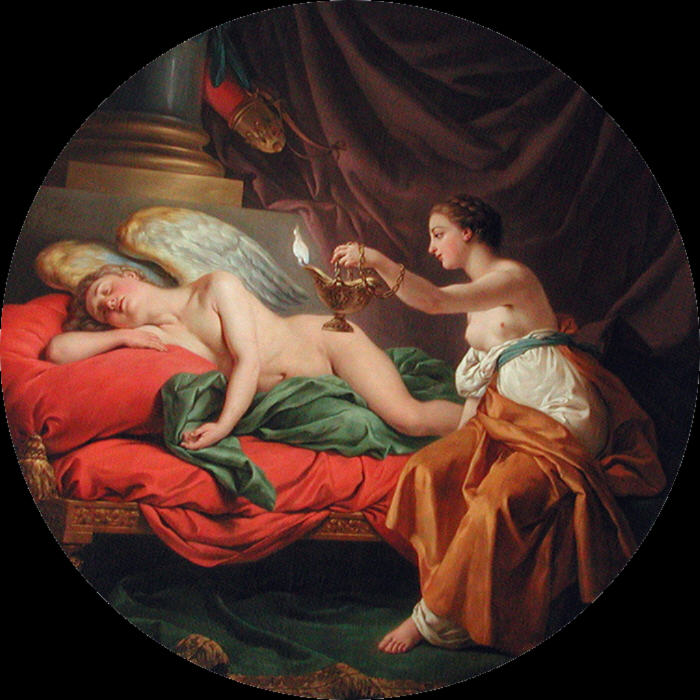
  10. Psyche lifts her lamp, and sees the divine. 
  11. Psyche pricks herself on one of his arrows, and falls in love with Love.
  12. Lamp oil burns Eros, and he sees betrayal and mistrust. He leaves her. She is disconsolate.
  13. Psyche wanders in search of her husband. She comes upon a magnificent temple and hopes to find her love. It is a temple to Demeter (Goddess of Fertility, Grain, and Agriculture). Psyche sorts and arranges the food offerings. Demeter cannot help her, but advises Psyche make amends with Aphrodite.
  14. Aphrodite sends Psyche on four impossible tasks, and with each task, Psyche weeps, and receives help: ants help with sorting grain; the reeds advise her on gathering golden fleece; the eagle of Zeus fetches her water from the river of life; and a voice from the tower she climbs to throw herself off advises her on the trip to the underworld to fetch a drop of Persephone's beauty. Another version has Eros secretly helping these along. 
  15. Returning from the underworld, Psyche realizes she looks bedraggled and fatigued with pregnancy. She opens the box for a bit of that beauty and a mist envelopes her, putting her to sleep.
  16. Eros finally comes along, and gathers up the mist and returns it to the box, and revives Psyche.
  17. Eros takes her to Olympus and Zeus makes her immortal as a wedding gift. Aphrodite is fine with that, as Psyche will no longer be on earth seducing mortals away from her.
Next I want to revisit the neuro-chemicals of love, and see how that fits with the story.


Tuesday, November 20, 2012

Adventures in Dating


The good news is that my campaign to lift myself out of depression is working.  That bad news is that it is keeping me too busy to find time to write, though I have been percolating with ideas, and that wasn't happening when I was depressed. I've also been too busy to read so much. As a bonus, I've found that I want to be more active...and here I was beating myself up for not being active enough, with that inactivity affecting my health.  It proves once again my hypothesis if everything is working the way it should, we will do what is right for our bodies.  I was depressed, and didn't feel like getting out and moving.  In fact, it could hurt more, aches and pains, getting older. Not so depressed, there is lightness in my step, and I feel invigorated rather than fatigued.  So the lesson once again is, rather than place the blame on laziness, look for the reasons underlying the symptom.
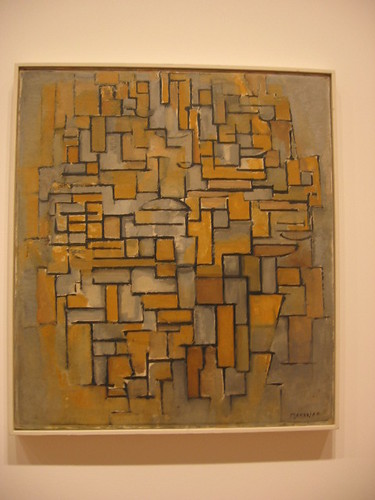
Mondrian's Composition in Brown and Gray
Just the knowledge that I've been depressed helped me lift myself out, some.  Thanks to my Buddhist training, I have the skill to catch a thought at its inception (sometimes) and when I could catch that thought, I could also make a choice.  I would say to myself, "Oh, there's that depressed impulse again. I don't need to fall into it."  And I would look up, rather than hunker down in. Let me say that I don't think people who are ill can just decide not to be sick, and people with depression can just decide not to be depressed.  In my case, I am not naturally prone to depression, and I don't think I was severely depressed, though it must have been going on for a long time. With this awareness, I could steer myself toward my more natural positive state of mind.

The other main action has been my adventures in dating.  I can't count the ways I am grateful for my relationship with my sweetie, nor can words say how deeply I love him.  I believe our freedom makes this deep love possible.  We are a lot of things to each other, but we don't have to provide everything the other wants or likes, nor do we expect it from each other. I have no reason to be resentful or disappointed, and I'm not.  He loves me even though I'm a pack rat and leave messy habitats wherever I go!  When has a couple been evenly matched on how often they want to have sex? When have they been interested in the same exact things? What we do expect is honesty and consideration; these are the signs our relationship is healthy. On my adventures in dating, I have the freedom to seek what I need with the comfort of knowing my existing love will not be torn apart.

Just as an aside, I learned a few things about this particular scene.  One thing, online dating is the thing for us fat women.  All I have to do is wait, and those who are looking for someone exactly like me come and find me.  I don't have to approach only to be rejected.  They find me!  Another thing, there are a lot of way younger guys who are looking for older, large women.  What's up with that?  I was talking to another quite bosomy woman who is thirty-three. (I, if you haven't been keeping up, am forty-five.)  We were comparing our experiences with online dating. She said she seems to attract older, creepy guys. I said I too have had interest from some older guys, but have been surprised by how many younger men are interested in me, and not just geek boys (who are sexy) but fit, athletic guys.  Just that alone patches up a whole bunch of tears in self-esteem that might still exist from years of being considered too fat to be sexy.  When I said she should go to the site I'm using, she said, "Oh, I'm too young."  They might be twenty, but these particular guys are looking for me, not her.  Baffling, but hey! I'm not looking for that much younger, but I'll give them a chance.

Another thing learned, sexting is the thing they're into.  Instead of talking on the phone and getting excited, or chatting online, they're looking for sexy texting.  Oh, that is hard on my thumbs.  And then sometimes it turns out that's all they are looking for, and when it comes time to actually meet me in person, they turn into flakes. Hmmm.   Finally, I've learned it's a little suspicious if they don't post a photo as part of their profile...could be a sign of cheating.  This is the thing that's difficult to navigate.  I don't want to poach, so the ones who are honest are left to continue suffering, but the liars get to cheat all they want until their actions start to reveal their secrets.  I feel for the honest ones, I do...they aren't getting what they need, and they don't see a way to find it in their existing relationship. They still love, but don't know how to fix what's broken. I think the sexting without follow-through may be related to this, that these guys are seeking stimulation without it seeming to be cheating.

If you're reading, you who don't want to be cheating dogs, you need to be brave and talk to her. Tell her what you've always wanted and haven't been able to find with her, but that you love her. And that you want her to have a way to find what she's always wanted too.  We always change, all of us, and our needs change, while our love remains.  Yes, the monogamist way is often to break it off, to allow the love to wither, and to seek the next monogamous partner that newly meets our needs. Or to cheat. Sometimes, and this has to be very hard, steer the changes together so that the two still mesh.  Sometimes this is possible, many loves, to seek new loves, or simply to date, while consciously nurturing this love you've dedicated so much of your life to.  How could you tear it apart? You could be surprised. If you are careful, and considerate, and take it slowly, you could find what you're looking for and keep what you have.

Psyche looks upon the divine Eros
I've found those endorphins I needed. I found that boosts to the ego sure help lift depression as well.  I've had some awkward encounters, some nice encounters, some really hot encounters, and one very profound encounter. At the time I told him I felt we touched a bit of heaven.  Later I told him I felt the act we shared opened a gateway and returned a piece of me to me, and it was a sacred moment.  All these encounters helped with endorphins, but this one, I think, brought the healing I needed.  Then, of course, I struggled with attaching to that and falling a little bit in love...how could I not?  Classic Eros and Psyche. (That's another writing project.)

Tuesday, November 06, 2012

Elections

I can't believe I'm doing this, writing about elections on election day.  I've avoided just about all election coverage I could.  No, I didn't watch any of the debates.  Why would I want to see someone I would like to do better, and another that just about makes me sick to watch, when I knew I was voting for not-that-guy?  (Though I was particularly proud of my book groupies who wanted to come to the October book group and also wanted to watch one of those debates, and someone shared that it would be on hulu, so they all came to the book group and learned how to find it on hulu.)

So no, I don't know what inspiring things Obama has been saying, things that I now would not entirely trust. I hold a little hope that if he does win, that is if the election isn't stolen from him, that he could bring about some more of the changes he promised last time, such as withdrawal of troops from Iraq, and bring about more substantial change to the changes he has made, such a more universal health care. (now I better finish before it is all decided before our polls close here in Oregon)

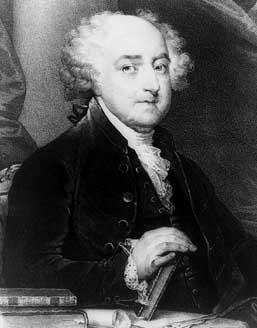
What I really came here to say is that I've been enjoying reading John Adams by David McCullough for our November book group during this election season.  While people I know have been grousing about our lack of true democracy in our nation on Facebook, I've been reading about the birth of our nation.

At home, [Adams] filled pages of his journal with observations on government and freedom, “notes for an oration at Braintree,” as he labeled them, though the oration appears never to have been delivered. Government is nothing more than the combined force of society, or the united power of the multitude, for the peace, order, safety, good and happiness of the people. . . . There is no king or queen bee distinguished from all others, by size or figure or beauty and variety of colors, in the human hive. No man has yet produced any revelation from heaven in his favor, any divine communication to govern his fellow men. Nature throws us all into the world equal and alike. . . . The preservation of liberty depends upon the intellectual and moral character of the people. As long as knowledge and virtue are diffused generally among the body of a nation, it is impossible they should be enslaved. . . . Ambition is one of the more ungovernable passions of the human heart. The love of power is insatiable and uncontrollable. . . . There is danger from all men. The only maxim of a free government ought to be to trust no man living with power to endanger the public liberty.   Part I, Chapter One, Section II, p. 55
 One of those friends asked why someone would want to become president, as they clearly age 20 years while in office, and yet, they turn around and do it again.  Talk ensued of attraction to power, of narcissism, etc.  Our manner of elections encourage this at almost all levels.  If a person enters the political arena from ideals, and a pretty good moral compass, it is difficult to retain authenticity and honor.  Good people often don't wish to taint their own moral ground by getting involved in politics. They effect change close to home, in non-governmental ways.

I got involved in the peace efforts thinking I acted not politically, but from the heart.  I felt a visceral response to someone calling it political action, but I had to realize, that is what taking it to the streets is.  It is political to vote. It is political to withhold a vote.  It is political to speak up about how the system stinks.  It is political to organize a permitted rally and march.  As soon as I have an intent to change someone's mind about how this society works together, it is political, no matter that it comes from the deepest faith in love from my heart.  In this we are all thrust "into the world equal and alike."

As I read McCullough's book, I am admiring John Adams because he did not get into politics for personal power. It is clear he got involved due to love of his homeland.  He did things he did not want to do, such as act as a Minister in Europe, first in France, then to the Dutch, then in Britain.  He was seven years away from his beloved wife, who finally joined him after her first dreaded Atlantic voyage. He did this to his own financial detriment, and often wasn't even thanked by the congress. His political action was from his heart.

I would like to have some choice. I would like to feel I live in a true democracy. We need to find a more effective way for our nation to reflect the "united power of the multitude." We need:
  1. Election day to be a national holiday. (duh)
  2. We need to consider individual voters innocent of fraud until proven guilty...so all those laws that prevent individuals from voting need to be rescinded, such as having to prove themselves with ID.
  3. We need to have equal access.  Thus there has to be enough places and equipment so people don't have to wait to vote, or have to prove they have the right to vote, or have to lose a job to take the time to vote.  People need to be able to register the same day they wish to vote.
  4. We need to prevent election tampering, and that means getting corporations with agendas out of the business.  It is currently much easier for one person to affect wide ranges of votes with a single machine, than it is for one voter to do something fraudulent.
  5. We need to have a choice, and by that I mean we need to be able to vote for more than two nominally polarized candidates. We need preferential or ranked choice voting, or instant run-off voting.  Or something as democratic.  So I could vote for my true choice, as well as vote for not-that-guy. I could vote for the woman who is not paid for by the corporations.
Have I forgotten something?  Please add to my list.

Thursday, October 18, 2012

How to Live: Or A Life of Montaigne...

How to Live: Or A Life of Montaigne in One Question and Twenty Attempts at an Answer My book group read How to Live: Or A Life of Montaigne in One Question and Twenty Attempts at an Answer in September.  That's a mouthful.  These convoluted titles seem to be a trend lately.  Don't let that stop you from checking out this book. Almost all of the book groupees loved this book, though some were hesitant to begin.

This was one of my subversive picks.  Since I am the one who tallies the votes for our year's picks, I get to target my votes.  I made sure this one made the cut.  I needed to have a reason to read this book, and sometimes, no matter how much I want to read a book, I won't get around to it unless duty calls...so I made sure duty called. Several of my co-conspirators in book group facilitation do the same thing.  And as I suspected, I loved it.  And I fell in love with Montaigne.  As I said in the book group, I am so jealous that I never get to meet Montaigne, that I can't travel back to his time.

This book also made me feel like I could begin blogging again.  How to live?  That is indeed the question of my life, right next to 'What does this mean, to be alive?'  Along with getting a taste of Montaigne and a peek at his life, we get the view of Montaigne down through history.  Individuals brought him forward into their age and found their own reflections in his essays.  There are the Stoics and the Romantics...everybody finds something in Montaigne. Pascal and Descartes hated him (as he anticipated and decimated their arguments).  Regarding thes two, some of what Sarah Bakewell says is this:

Descartes cannot truly exchange a glance with an animal. Montaigne can, and does. In one famous passage, he mused: “When I play with my cat, who knows if I am not a pastime to her more than she is to me?” And he added in another version of the text: “We entertain each other with reciprocal monkey tricks. If I have my time to begin or to refuse, so has she hers.” He borrows his cat’s point of view in relation to him just as readily as he occupies his own in relation to her.
This comfortable acceptance of life as it is, and of one’s own self as it is, drove Pascal to a greater fury than Pyrrhonian Skepticism itself. The two go together. Montaigne places everything in doubt, but then he deliberately reaffirms everything that is familiar, uncertain, and ordinary—for that is all we have. His Skepticism makes him celebrate imperfection: the very thing Pascal, as much as Descartes, wanted to escape but never could.

Montaigne was the first to write the essay, and now, in this world of personal blogs, we live his legacy.  He wrote like we do, in stream of consciousness, about anything he encountered and pondered in his life.  Unlike blogging, where we may never revisit our blatherings, Montaigne goes back, and inserts new thoughts into old essays, often, according to Bakewell, not bothering to make his difference in age make sense.  Some editions of Montaigne indicate different timelines with A, B, and C.  Of course, we do link back to our past lives in essays.

Montaigne is a man of my own heart.  He resolved to pay attention, and did so in his essays.  Of all the vows I have made through the years, this is my top pick.  I trust in paying attention.  All the while I was not blogging, at least I was paying attention.  Whatever I noticed may have slipped through the sieve of my brain...sometimes if writing is anything it is to catch the sand of thoughts before the grains slip through the holes...but I was waiting with my attention for something to give me a reason for my frozen state.

I hoped this book could inspire people to read Montaigne.  It certainly did me, and I hope to read Montaigne and find my reflection in him, as so many others have before me.  I've tried a slow read of hefty non-fiction tomes before.  I fizzled out with A People's History.  So, I only say, "I hope."  I only know my way in to blogging feels kinda broken, and perhaps I need a mentor of sorts, like Montaigne.  It won't just be a reading of a text, but it will be the query, "How to live?"  As I've mentioned, I don't seem to be able to stick to a plan unless I have an externally imposed deadline, so I'm making no plan.  Maybe I'll visit Montaigne once a week and reflect...maybe once a month, but I do know I look forward to meeting his mind.


Wednesday, October 17, 2012

Blogging About Books

I did a tiny little bit of blogging this past year...as a library book blogger.

They were seeking new blood for the library's blog, and I put my name in.  It's not very often, but gratifying.  I've been posting under the name Enji because there already was a Heidi writing for the blog.  This is going to end, and my future posts will be under the name Heidi H.

Here they are:

Great Books I Never Would Have Chosen
(I forgot to submit a title, so it's not exactly a title in my style.)

YA for Grown-ups: Historical Fiction Edition

Highlanders, Fairies, and Vampires, oh my!

YA for Adults: Tough Girls You'll Love

Mary Doria Russell: From Sparrow to Doc

In July, we had to cut hours and staff at the library, so the library's blog went from several posts a week to one post or less.  We all have less time to do these kinds of things, because you know if a library's hours reduce, there aren't necessarily any less items checked out, right?  We're just that much busier during the times we're open.

Untitled

Oh, should I mention, if you live in Multnomah County, you should be voting for the Library District?  That's right, I knew I didn't have to, because you already are planning to vote Yes.  You are not my friend if you are voting No. Ppffffthhht.

PS
Hey, I just noticed the Google Doodle for today is commemorating the 161st Anniversary of Moby Dick.  And a few minutes before that I noticed my own blog's post with the highest page views (6705) is Moby Dick: Chapters 29-34, from my slow read.  I don't know why that one over all the other ones.  My second-highest page view is Moby Dick: Chapters 55-60 with 2695 views.


Sunday, October 14, 2012

Ripening

How does one resurrect a dead blog? In 2010 and 2011 I tried with a few fizzles.  I consciously knew of some reasons. This has never been simply a book blog, but it was devolving into one.  My sweetie is never quite as comfortable as I am talking about certain things, and I was feeling hesitant about some topics for his sake. Whenever I come up with a plan, as I attempted to, I invariably lose some kind of impetus.  Is that self-sabotage?  Or is that feeling the loss of the energy of spontaneity?  I know I do well with the duty of deadlines, but I can never seem to trick myself into imposing them on myself.  In some ways, I didn't feel like I had much interesting to say.

IMG_0064 copy
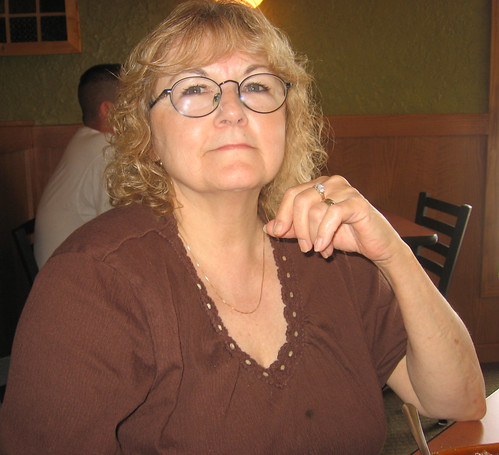
My mom, July 2007
More recently, though I felt the wish to write, and have had quite a few hefty topics I wished to write about, I'd think about it for a day and then never get around to it.  I was only interested in reading.  Reading became an obsession.  I was consciously aware I turned to predictable pap after my mom died.  Yes, my mom died and I couldn't bring myself to write about it here.  It was partly because I didn't know what to say, and partly because I didn't want to bring this thing back to life with a death. I knew I needed to grieve, but reading was a way to take a break.

Until it tilted over into my default activity.  If I didn't have anything else to do, and even if I did, I read.  I keep an eye out for free kindle books, but I buy many as well.  So much so that when my kindle stopped working, Amazon replaced it for free even though it was past warranty.  I certainly became too sedentary.

Even more recently, when I shared this embarrassing obsession a person at the right time suggested perhaps depression is involved. Often when I mentioned it, people said well if I'm going to have an obsession, reading is a good one to have.  This is why I'm embarrassed...no...it's not good when it affects my health, and not when I can't set it aside.

Fortunately, it has been my pattern that once something is conscious and able to be Named, its days are numbered.  Even just the thought sequence, 'oh yeah, i'm depressed, that's why this is hard' has lessened the feeling of depression.

Patrick, ?2009
So then, I started adding up the reasons why I could be depressed. Several deaths: a few years back, my nephew, and in January this year, my mom.  She was just a few days shy of 70.  And I've confessed it before to individuals, and I'll confess it now for the world to see, well, he even said it himself, her husband was supposed to die first.  He's a jerk, and someone should have diagnosed him a sociopath at least 30 years ago.  Then this May, my friend Patrick died almost immediately after a cancer diagnosis.  Happily, I was able to help with hospice vigil, and go out to lunch one last time along with his brother, oh jeez, was his name Brian?

Also in there I lost another friend.  After nearly 20 years, she broke it off with me.  There was conflict, but nothing that couldn't have normally been dealt with and forgiven. There's no divorce when friendships end, but there is heartbreak.

I'm sure there are other things that contributed to the sink into depression, including the reading thing that at first was a comforting salve, along with the lack of activity.

I am not prone to depression, which is perhaps why I couldn't see it.  Perhaps I didn't want to see it, as well.  One other time in my life I was seriously depressed, heartbroken. The thing that helped me climb out? Some feisty no-strings sex, along with some happy dope.  Ahhh, endorphins and dopamine!  At that time, meditation did not help, but now, with this creeping malaise, I think it would.

For now, I am seeking those fun endorphins (wink wink).  It is already helping.  I've started keeping my Dharma School blog again, and here I am, excited to write again, feeling like I might have something interesting to say.  I feel the urge to take photos again.  I appreciate the friends I still have, and the deepening friendship of a couple in particular with whom I can talk about anything...I mean anything.  Perhaps soon I will be able to pick up that daily habit of meditation again.  Oh, and since I picked up those extra endorphins, I have actually put the kindle away for hours at a time!


Wednesday, November 09, 2011

Thoughts on facilitating a book group

Fall yellow with library stained glass
I've been reflecting on the different ways I've been involved with books and groups lately.  For the classes on "Soto Zen" I wasn't very comfortable putting myself in a position of being the authority.  When an instructor, I work best more as a facilitator.  I count on the wisdom of the group, and don't expect that I will have all the answers.  Still, as the leader in a situation like this, they look to me to talk the most.  Something I had to learn from this series was how to create more specific open-ended questions than I am used to, though I still wanted to resist my mentors' tendencies to ask questions intended to solicit specific answers.  I also resisted the suggestion that I have some summary statements ready, as this would assume I knew just what would be pulled out of the class discussion.   To me, a successful class happened when participants pulled something out of the material that had passed me by.

St. John's College, Santa Fe
I primarily want to talk about facilitation of a book group, but before that I want to touch on my experience with my fellow alumni and our seminar discussions.  Seminar is our collegiate word for our book groups fashioned after our particular college experience.

Unlike other book groups, we aren't expected to bring in background information on the author, on the history of the times, or especially other people's interpretations on the work.  Almost as a rule, we skip the Introduction.  We expect the book or selection to speak to us on its own merits.   We generally begin with a question that arises from the text, and discussion ensues from there.  We're quite all right with a weighty silence as we digest the question and our thoughts on how we can pull responses from the text and our interaction with it.  Unlike our college experience, some of us may bring in background historical information, just for fun, and to elucidate the text.  For example, we just read Frankenstein, and I found it useful to find out when grave-robbing for medical experiments was at its height. We don't make efforts to make sure everybody has a chance to speak, or to head someone off at the pass who is talking too much. We are a leaderless group, and after the opening question, more questions may arise and no conclusions may be reached.  There can be moments where we are awed by the results of our collective inquiry.

I bring aspects of this sensibility to my facilitation of book groups.  Over time, regular attendees begin to get it as I guide them to raise questions that explore what we can get out of this book, what it teaches about the world and ourselves, and move beyond the impulse merely to allow the book to entertain and inform.  A book really comes alive when we can interact with it, explore implications, argue with it, and learn a deeper knowledge within ourselves.

Sometimes the books we read urge us to look at our own experiences and family histories and share them with others.  Sometimes the books need to be figured out, and sometimes those books have no correct answers.  If we all just say, "I liked this," "I loved that," or "I hated it," there isn't much discussion to be had.

If I have the time, I will look into historical background, author biographies, and other related information that occurs to me.  I'll have that available if it comes up during the conversation.  Even better, I'll simply have a computer with me if we want to look up some factoid.  A tablet or smartphone could do just as well, but a laptop at least will have a screen large enough to share images.  Rarely will I kick off a book group with a monologue of information.  It's much more interesting to volunteer the information as a need for it arises.

I'll usually begin a group with a round robin, asking people to say their names, and what they hope to talk about from the book.  Even with that question, people will still say how they loved or hated the book, but enough will have questions or themes they want to explore.  When people get excited and start talking at once, or a couple have a side conversation, I'll raise a finger and ask for one conversation at a time.  If there is enough time, I'll ask for another round robin, asking for reflection, or if there's something anybody didn't get a chance to say.  Sometimes, a book has so much depth to figure out, I'll ask an opening question just like at St. John's, but then also ask for a round robin reflection about twenty minutes before closing.

Soto Zen by Keido Chisan

From September 14 to October 12 I co-led a class on Soto Zen: An Introduction to the Thought of the Serene Reflection Meditation School of Buddhism by Keido Chisan Koho Zenji at my Zen Center.

My co-teacher, Daicho, was able to give biographical information on Keido Chisan from a biography only available in Japanese.  The audio from the first class on this and the first chapter can be found here. Thinking of our class series, Daicho shared his thoughts on why Keido Chisan felt so driven to bring Soto Zen to the West, and to the United States in particular, and shared details from Keido Chisan's life that supported this.

More recently, Zen Center member Unkai published her paper on Keido Chison in the newsletter, found here. She concentrates more on Keido Chisan's younger years.

Unfortunately, the 2nd class on September 21 did not record correctly...nor did the 4th class...and I thought these were our most successful classes as discussions go.  (This happens because there is no way to double-check in real time that the recording is actually happening, they tell me.)

Chapter 2 really started to make sense to me when I realized I could express it in a diagram.  It was interesting to us that while the three foundational concepts of Buddhism that we usually talk about are anicca, anatta, and dukkha, in this case Koho Zenji talked about anicca, anatta, and karma (without naming them as such, but using English definitions for the "laws").  Altogether, these three laws allow what we think of as the self, always changing.  If I remember right, during class someone asked me where I thought dukkha (life is marked by dissatisfaction) fit.  I responded that dukkha flavors the whole thing.  The more one is subject to dukkha, and the clinging to the self being a certain way, the more separate from all beings, the more solidified the flawed self is, and the more unaware one would be of the middle of the triangle.

One of our monks pointed out that the inside of the triangle reflects the transcendent experience.  This pleased me, as I am tickled when something I create fits together even better than I originally conceived.

This diagram represents these statements by Koho Zenji in Chapter 2:

In Mahayana Buddhism we combine these three signs and say that they are but the One Sign which reveals the True Nature of all things. When we view the nature of things with the eyes of enlightenment, we see that all things are manifestations of Truth.


The law that all things are impermanent, based on the doctrines of causation and no-soul, ultimately developed into the concept of ku expounded in the Scriptures of Great Wisdom.


The law of causation, aided by the laws of impermanence and no-soul, was gradually deepened and led to the doctrine of phenomenal identity of the Kegon Kyo. Phenomenal identity is the name given to the idea that all phenomena have a deep, inseparable interrelation. Everything is related in both time and space to everything else, forming an inseparable whole, yet functioning freely.


The law of the non-existence of the soul, supported by the laws of causation and impermanence, led to the development of the idea of the Buddha Nature. The Buddha Nature is the essence of the Buddha. It is That which makes him Buddha.
Think about how radical this is, this Buddhism in the West. No soul, no God, no separable identity.

For the 3rd class on September 28, we discussed Chapters 3, 4, and 5, audio found here.

For the 4th class on October 5, we planned to discuss Chapters 6 and 7, but only got through Chapter 6.  We discussed sectarianism, and what the good and the harm could be.  We asked the question, "Why do we practice?" considering Dogen's teaching that training and enlightenment are the same, and Koho Zenji's statement, "Just-sitting based on faith is the fullest form of enlightenment." We also asked what people thought their Buddha Nature is, keeping in mind that as soon as we try to put words to it we would fall short.  We wanted to have fun with that, though with many newbies in the class, many thought they couldn't express this.  Mine, for example, is sparkly. Ebullient. In my younger years I did not have access to this consciously.

Koho Zenji says of Keizan, who is said to be the compassionate mother of Soto Zen, and who brought us our ceremonies,

We must enable them to know the joy that comes from a knowledge of the Dharma and the bliss that comes from the practice of meditation. It is absolutely essential to have a personal character like that of Great Master Keizan in order to carry out this mission. To regard all people with warm affection, to become the friend of the common people, to enter the realm of the ideal together with them and to share one's joy with others. These are the characteristics of the true man of religion.
We asked people to share this joy and bliss that came from their experience in a ceremony.  This particularly would have been nice to have captured in the audio.

Finally, the 5th class on October 12 can be found here.

Wednesday, October 19, 2011

Fat Karma: Recovery from the Diet Paradigm

me
My home altar, Prajnaparamita, Peace, and me
This would be as good a time as any to resurrect my Fat Karma series. This post is part of the 2011 Love Your Body Day Blog Carnival.  To see if I have covered this topic before, I skimmed over those posts and others with a related label, and found this phrase of mine, "recovery from the diet paradigm."  I think it's my own phrase...maybe I picked it up somewhere.  It's certainly how I've been thinking about this for many years.

I have said before that I had a consciousness of diet by the age of six. I would not be surprised if this is the norm, that a child is likely to be aware of good and bad foods, calories, the need not to be fat, and the word 'diet'.  The child unhindered by this consciousness is most likely the exception.  The histrionics of this eating disordered society has become even worse in the decades since my own childhood.

I grew to be a teen who could not believe she was beautiful, sexy, pretty, because she'd always received the message that she weighed too much to be any of these things.  This affected my sex life in college.  Even if given messages that I was sexy, I couldn't quite believe it.  Even though I'd never thought I'd be the marrying type, I settled with one guy and did marry him, because though I wasn't quite conscious of the reason, deep down I was afraid no one else would have me, so I loved the one I was with.

I didn't know it at the time, but the day I started practicing meditation was the day I would begin to love my body.  It would take a few years before I could get a glimpse of this, and several more years before I could believe, and even more before I could consistently act from a place of loving myself, my whole self, including my body, and my big belly.

A defining moment: post-college, in my twenties, with my first husband here in Portland.  I sat down with a plate-full of rice and beans (I'd been a vegetarian since twenty-one).  My husband worried that I would keep getting fatter.  I don't remember precisely what he said, what he started yelling, but I remember the certainty in my response.  I told him that what I was doing, my Buddhist practice, was the right thing for me, and would help me with this issue.  That being fat or overeating was not the problem, it was the symptom.  I knew that meditation gave me access to myself, and that my friends at the Zen Center, who were my mirrors, and my teacher, would continue to help me access myself, and get to the root of the problem.

I still spoke with the language of the diet paradigm, but this was a first step to recovery.  I knew something had happened with meditation: I could no longer diet.  I trusted this practice, though, as from the very beginning it gave me access to something I hadn't had before...my own inner voice.

Now I realize I could no longer diet because what you must do in order to diet is ignore the signals coming from your body.  You mustn't eat when you're hungry, but you must eat only certain things, certain amounts, and at certain times.  You mustn't eat for pleasure, for good taste, but for minimum sustenance and lowest calories, no matter what your insides, your mouth, your eyes, your nose tells you.  To do this, you must separate from the pain, from the hunger, from the body.  Meditation put me back in my body; ignoring my body's voice was no longer an option.  I now know this is a central message of Health at Every Size, that if we listen to our body's signals, eat what satisfies our true hunger, we will be unlikely to be subject to the cycle of deprivation and binging that results from dieting and food restriction.  No food is good or bad.  No food is forbidden (unless you're allergic).  Food that is appreciated is food that satisfies.  In my experience, I then need less of it.

Included with my meditation practice during these years was a recurring vow to Pay Attention.  As part of this, I noticed that even though I worked on my feet eight hours a day, walked to and from work for a total of more than an hour, was a vegetarian, I did not lose weight.  I noticed during meditation retreats when we shared meals, it did not matter the size of people, but some people ate more than me, and some people ate less than me.  While we are to set aside comparing mind during a retreat, in this mode of paying attention I began to get the message that I actually ate normally.

Also during this time I took a temporary vow not to eat chips or chocolate.  This three month period taught me the ways I could squirm around a limit (I ate non-chocolate candy), but the larger lesson was learned after the vow was over. I am so grateful for this tradition at my temple, the temporary vow to intensify one's practice.  I might have benefited from a Catholic upbringing.  When it was over, I made the return to chocolate and chips a special occasion.  While I'd mindfully abstained, after, I mindfully ate, and I found an incredible gift.  I truly enjoyed that chocolate, those chips, and I realized before this vow, I'd never truly eaten them.  Previously, while I ate, I also ate the guilt, and the shame, and the belief that I shouldn't really be eating them. I realized this not-eating happened with all food I ate.  I would never not-eat when I ate again.

When I could be grateful, and love the food I put in my body, I could truly begin to make choices that nourished my whole self.  I could truly begin to choose foods out of love for my body, including my body's health and my body's pleasure.

A very similar thing went on with my view of my body.  I couldn't just look at my body.  I could only see parts of it at a time.  I couldn't like certain parts of my body.  I couldn't include these as parts of me.  Again, with this recurring vow of Pay Attention, I heard it when my inner voice said, "I could be bisexual."  I began to notice, and cultivate an awareness of those aspects of a woman I found attractive.  I noticed that I could like a generously curved woman, appreciate the parts much like the parts of myself I couldn't look at, and I would realize, if she shared parts just like mine, and I liked how she looked, why couldn't I like how I looked?  I learned to lose the warped vision that comes from an eating-disordered society.

Through this process, I finally reached a point where I could believe it when a man, or a woman, told me I looked sexy.  When I am truly in my body, enjoying the ways it can feel, it can move, I am loving my body, and that is sexy.

Once I gave up this language about myself, this hateful self-talk that is the diet paradigm, and I made every effort to notice it, root it out, and change the habit of self-degradation, I noticed how many people disparage themselves with it, no matter what size they are.  It's insidious, how much it is part of our culture.
Thursday, October 13, 2011

Eastern Oregon Trip: Thomas Condon Paleontology Center

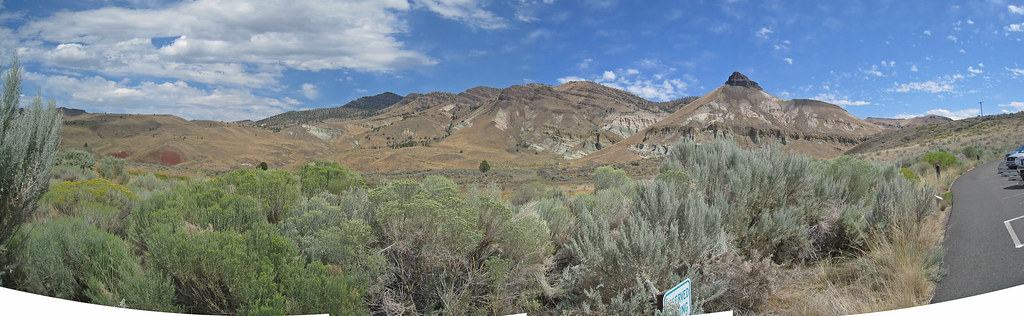
view sheep rock
View of Sheep Rock from the parking lot of the Paleontology Center


It was while we were in the John Day Fossil Beds National Monument that we left HWY 26 and turned north on Oregon HWY 19.

I was excited to visit the Thomas Condon Paleontology Center, two miles after our turnoff.  I was reading Your Inner Fish for my library book group.  I find the fossil record fascinating.  When I was a kid I had a small fossil collection, several of which were found in my rural Wisconsin back yard.  (I have to ask my mom if that's still around.)

In 1859 Charles Darwin published The Origin of Species.  Fossils were the big thing among a certain set.  A minister and self-taught scientist in The Dalles, Oregon, Thomas Condon, heard about abundant fossils from soldiers in 1862, and in 1865 he began excavating fossils in this area. Condon eventually became a Professor of Geology at the University of Oregon.

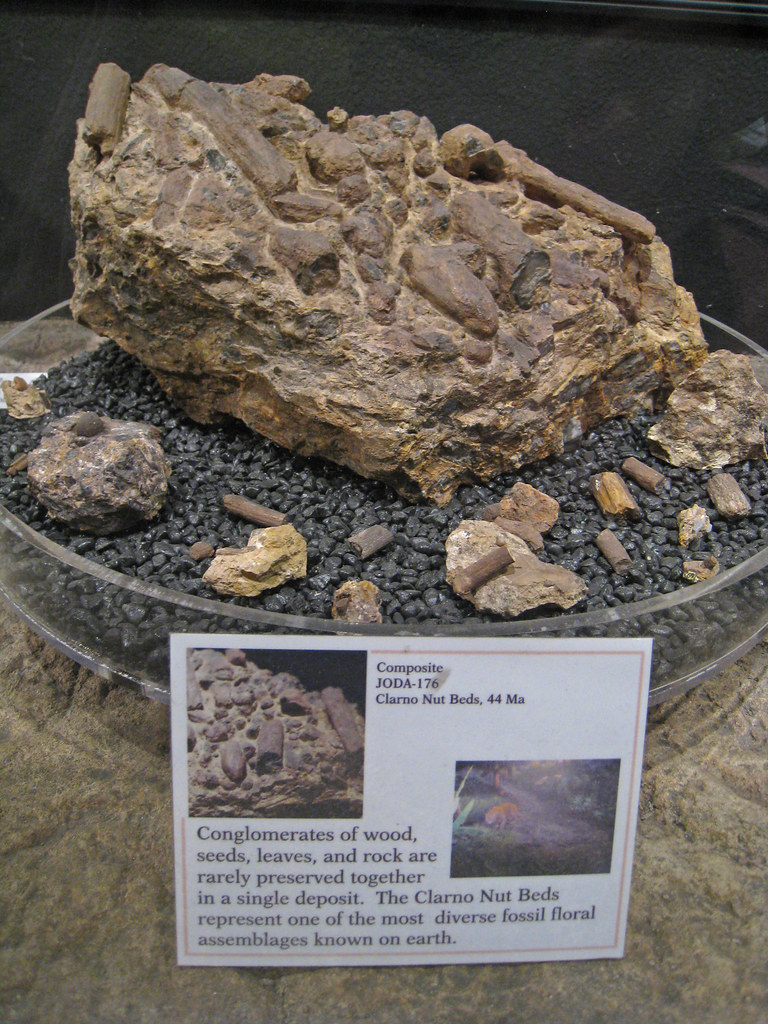
IMG_5755_1A few minutes after arriving at the center, a short movie about the John Day Fossil Beds and paleontology was announced.  We learned there are fossil beds throughout 10,000 square miles of Eastern Oregon. The National Monument is 20 square miles of protected area.  The John Day Fossil Beds in particular are very diverse.  Six distinct ages ranging from 7 million to 44 million years ago can be found there. The fossil record is so reliable there that paleontologists around the world "are looking to this formation for correlation."

I'd learned in Your Inner Fish that lava beds were not good places to find fossils because the molten lava destroyed the beings it killed, and that former sea beds were good places to find fossils.  In this case, it was volcanic activity that created these profuse fossil records, but it was mud flow that covered over and smothered everything, and since it was so fast, it was like a snapshot of all the living beings at one time, encased in mud which became rock.

While Thomas Condon must certainly have kept a record of where he found fossils, these days paleontologists can keep notebooks with precise locations, times, and pictures printed on the spot.  In this rich territory in Oregon, a paleontologist can find "an entirely new basin that no one has collected before."

IMG_5765_1
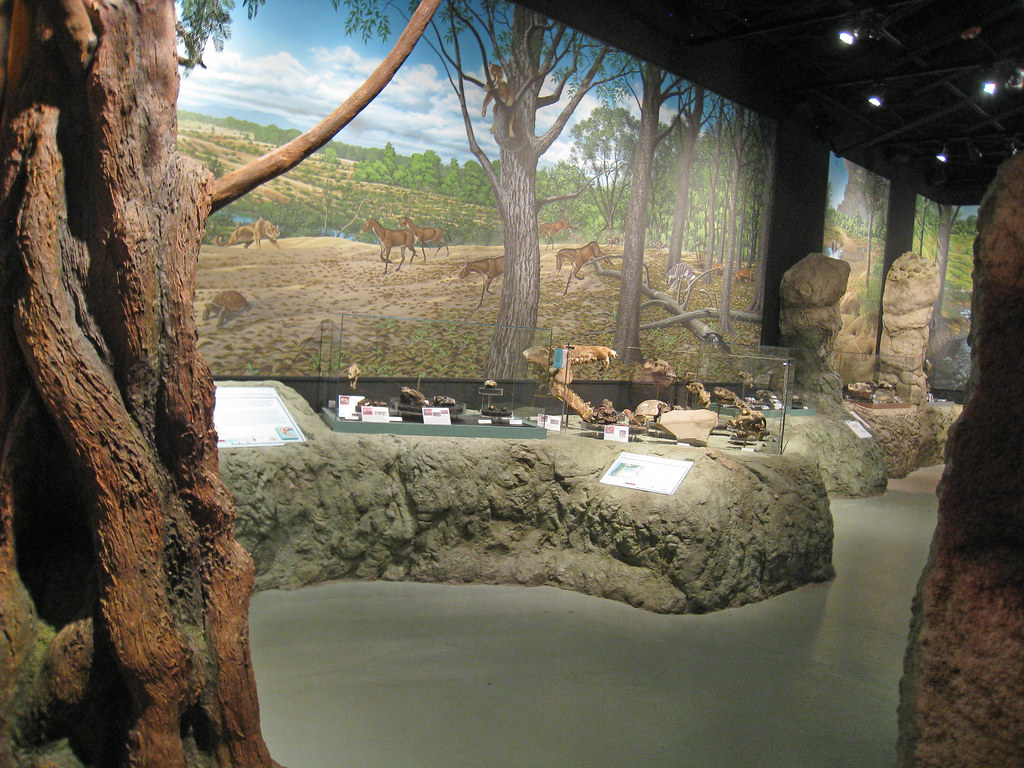
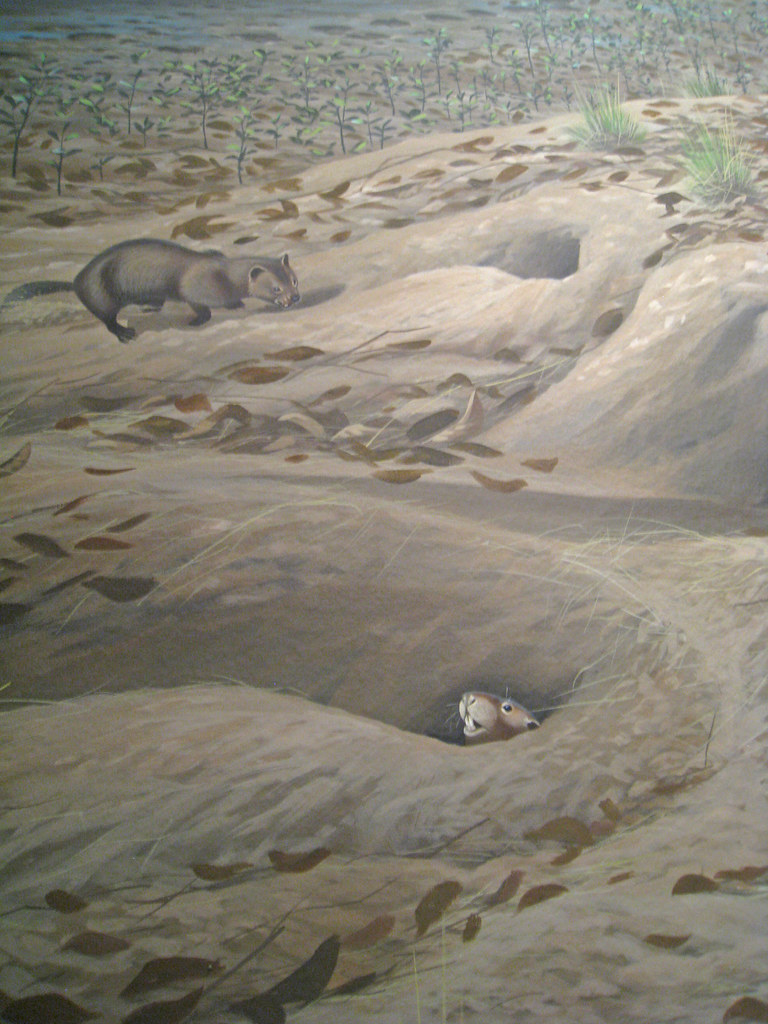
I can't recommend enough visiting this place as part of your visit to Eastern Oregon.  It can't compare to the American Museum of Natural History, but it is chock full of information, and because of the unique fossil record of the area, has a wide range of fossils, post-dinosaurs. Wall murals depicting the animals and plants as they may have looked line the walls (well-done, not hokey as I remember museum visits from my childhood) and the exhibits are displayed as if on exposed rock.  I took a bunch of pictures to look at later but there are plenty of photos and other things to explore at the National Parks website. (I may have more description work to do with those photos of mine, so check back later.)

IMG_5779_1

Wednesday, October 12, 2011

Slow Read: Middlemarch Book 8 and Finale

MiddlemarchBOOK VIII. SUNSET AND SUNRISE. 


CHAPTER LXXII. Full souls are double mirrors, making still An endless vista of fair things before, Repeating things behind.

 "I feel convinced that his conduct has not been guilty: I believe that people are almost always better than their neighbors think they are," said Dorothea. Some of her intensest experience in the last two years had set her mind strongly in opposition to any unfavorable construction of others; and for the first time she felt rather discontented with Mr. Farebrother.
Dorothea will be a champion for the buffeted Doctor.  She also defies Sir James.
But Sir James Chettam was no longer the diffident and acquiescent suitor: he was the anxious brother-in-law, with a devout admiration for his sister, but with a constant alarm lest she should fall under some new illusion almost as bad as marrying Casaubon. He smiled much less; when he said "Exactly" it was more often an introduction to a dissentient opinion than in those submissive bachelor days; and Dorothea found to her surprise that she had to resolve not to be afraid of him--all the more because he was really her best friend. He disagreed with her now. "But, Dorothea," he said, remonstrantly, "you can't undertake to manage a man's life for him in that way. Lydgate must know-- at least he will soon come to know how he stands. If he can clear himself, he will. He must act for himself."
I like Sir James, but I can't help but feel he is too unkind here.  I guess he's more concerned for harm Dorothea might experience, than that a man's life could be ruined over something he didn't do.  Or would his compassion allow him to let a man sink or swim in a pool full of sharks?
Besides, there is a man's character beforehand to speak for him." "But, my dear Mrs. Casaubon," said Mr. Farebrother, smiling gently at her ardor, "character is not cut in marble--it is not something solid and unalterable. It is something living and changing, and may become diseased as our bodies do." "Then it may be rescued and healed," said Dorothea "I should not be afraid of asking Mr. Lydgate to tell me the truth, that I might help him. Why should I be afraid?
Whereas once Dorothea was innocent and passionate, insisting on a course that would inevitably be harmful, now she seems to be the only reasonable person due to that same passion tempered by experience.  Why should she be afraid?
People glorify all sorts of bravery except the bravery they might show on behalf of their nearest neighbors." Dorothea's eyes had a moist brightness in them, and the changed tones of her voice roused her uncle, who began to listen. "It is true that a woman may venture on some efforts of sympathy which would hardly succeed if we men undertook them," said Mr. Farebrother, almost converted by Dorothea's ardor.
I wonder if this is a key passage.  Is this the difference between men and women in the public sphere?  The difference between a savvy cleric and a saintly heart?  Why would this kind of effort of sympathy be unlikely to succeed if men undertook them?

CHAPTER LXXIII. Pity the laden one; this wandering woe May visit you and me.

Lydgate mulls greatly, how to present himself?
He would not retreat before calumny, as if he submitted to it. He would face it to the utmost, and no act of his should show that he was afraid. It belonged to the generosity as well as defiant force of his nature that he resolved not to shrink from showing to the full his sense of obligation to Bulstrode. 
CHAPTER LXXIV. "Mercifully grant that we may grow aged together." --BOOK OF TOBIT: Marriage Prayer.

How Middlemarch lets a wife know her place, thanks to her husband's actions:
Candor was one. To be candid, in Middlemarch phraseology, meant, to use an early opportunity of letting your friends know that you did not take a cheerful view of their capacity, their conduct, or their position; and a robust candor never waited to be asked for its opinion. Then, again, there was the love of truth--a wide phrase, but meaning in this relation, a lively objection to seeing a wife look happier than her husband's character warranted, or manifest too much satisfaction in her lot--the poor thing should have some hint given her that if she knew the truth she would have less complacency in her bonnet, and in light dishes for a supper-party. Stronger than all, there was the regard for a friend's moral improvement, sometimes called her soul, which was likely to be benefited by remarks tending to gloom, uttered with the accompaniment of pensive staring at the furniture and a manner implying that the speaker would not tell what was on her mind, from regard to the feelings of her hearer. On the whole, one might say that an ardent charity was at work setting the virtuous mind to make a neighbor unhappy for her good.
Catty, dark, mean, this gossip thing. Cue Kristen Bell, Gossip Girl narrator.  Kristen, read this for me, please?  No one could do it more justice.

Oddly, though, no one wished to tell Mrs. Bulstrode.  They didn't want to be mean to her. And when she does find out, first she mourns, then she stands by her man. One of the most touching moments in the book, I think.
He sat with his eyes bent down, and as she went towards him she thought he looked smaller-- he seemed so withered and shrunken. A movement of new compassion and old tenderness went through her like a great wave, and putting one hand on his which rested on the arm of the chair, and the other on his shoulder, she said, solemnly but kindly-- "Look up, Nicholas."
And in that simplicity, there is still complexity:
They could not yet speak to each other of the shame which she was bearing with him, or of the acts which had brought it down on them. His confession was silent, and her promise of faithfulness was silent. Open-minded as she was, she nevertheless shrank from the words which would have expressed their mutual consciousness, as she would have shrunk from flakes of fire. She could not say, "How much is only slander and false suspicion?" and he did not say, "I am innocent."

CHAPTER LXXV. "Le sentiment de la fausset? des plaisirs pr?sents, et l'ignorance de la vanit? des plaisirs absents causent l'inconstance."--PASCAL.
The sense of the falsity of present pleasures, and ignorance of the vanity of absent pleasures, cause inconstancy.
Meanwhile, Rosamond courts Ladislaw.
She even fancied--what will not men and women fancy in these matters?-- that Will exaggerated his admiration for Mrs. Casaubon in order to pique herself. In this way poor Rosamond's brain had been busy before Will's departure. 
CHAPTER LXXVI. "To mercy, pity, peace, and love All pray in their distress, And to these virtues of delight, Return their thankfulness. . . . . . . For Mercy has a human heart, Pity a human face; And Love, the human form divine; And Peace, the human dress. --WILLIAM BLAKE: Songs of Innocence.

Dorothea follows through:
"Not because there is no one to believe in you?" said Dorothea, pouring out her words in clearness from a full heart. "I know the unhappy mistakes about you. I knew them from the first moment to be mistakes. You have never done anything vile. You would not do anything dishonorable." It was the first assurance of belief in him that had fallen on Lydgate's ears. He drew a deep breath, and said, "Thank you." He could say no more: it was something very new and strange in his life that these few words of trust from a woman should be so much to him. "I beseech you to tell me how everything was," said Dorothea, fearlessly. "I am sure that the truth would clear you."
She is like a balm on his heart.  She even will help him with his marriage, though I wonder at the good that will do.
 following the impulse to let Dorothea see deeper into the difficulty of his life, he said, "The fact is, this trouble has come upon her confusedly. We have not been able to speak to each other about it. ... "May I go and see her?" said Dorothea, eagerly. "Would she accept my sympathy? I would tell her that you have not been blamable before any one's judgment but your own. I would tell her that you shall be cleared in every fair mind. I would cheer her heart. Will you ask her if I may go to see her? I did see her once." "I am sure you may," said Lydgate, seizing the proposition with some hope. ".... I will not speak to her about your coming--that she may not connect it with my wishes at all."
CHAPTER LXXVII. "And thus thy fall hath left a kind of blot, To mark the full-fraught man and best indued With some suspicion." --Henry V.
There was evidently some mental separation, some barrier to complete confidence which had arisen between this wife and the husband who had yet made her happiness a law to him. That was a trouble which no third person must directly touch. But Dorothea thought with deep pity of the loneliness which must have come upon Rosamond from the suspicions cast on her husband; and there would surely be help in the manifestation of respect for Lydgate and sympathy with her.
Oh...if only Rosamond were as Dorothea imagines.

CHAPTER LXXVIII. "Would it were yesterday and I i' the grave, With her sweet faith above for monument"

In which Rosamond makes a move for Will, who is thoroughly disgusted, and Dorothea happens upon them at just the wrong moment.  Well, even though he hasn't been cleared in the eyes of his wife, Lydgate shines at what he does best.
"...Rosamond! has something agitated you?" Clinging to him she fell into hysterical sobbings and cries, and for the next hour he did nothing but soothe and tend her. He imagined that Dorothea had been to see her, and that all this effect on her nervous system, which evidently involved some new turning towards himself, was due to the excitement of the new impressions which that visit had raised. 
CHAPTER LXXIX. "Now, I saw in my dream, that just as they had ended their talk, they drew nigh to a very miry slough, that was in the midst of the plain; and they, being heedless, did both fall suddenly into the bog. The name of the slough was Despond."--BUNYAN.
We are on a perilous margin when we begin to look passively at our future selves, and see our own figures led with dull consent into insipid misdoing and shabby achievement. Poor Lydgate was inwardly groaning on that margin, and Will was arriving at it. It seemed to him this evening as if the cruelty of his outburst to Rosamond had made an obligation for him, and he dreaded the obligation: he dreaded Lydgate's unsuspecting good-will: he dreaded his own distaste for his spoiled life, which would leave him in motiveless levity.
I wonder if any other of the men would have felt this obligation after a burst of cruelty.  Mr. Garth perhaps.  Would others have even realized how they were cruel?  Not Sir James. Not Mr. Brooke. Mr. Farebrother wouldn't have got himself in that position: I think he'd see enough clues to avoid it.

CHAPTER LXXX. "Stern lawgiver! yet thou dost wear The Godhead's most benignant grace; Nor know we anything so fair As is the smile upon thy face; Flowers laugh before thee on their beds, And fragrance in thy footing treads; Thou dost preserve the Stars from wrong; And the most ancient Heavens, through thee, are fresh and strong. --WORDSWORTH: Ode to Duty.

Ahh...some comic relief via Miss Henrietta Noble.
...when suddenly some inarticulate little sounds were heard which called everybody's attention. "Henrietta Noble," said Mrs. Farebrother, seeing her small sister moving about the furniture-legs distressfully, "what is the matter?" "I have lost my tortoise-shell lozenge-box. I fear the kitten has rolled it away," said the tiny old lady, involuntarily continuing her beaver-like notes. ..."Oh, if it is Ladislaw's present," said Mr. Farebrother, in a deep tone of comprehension, getting up and hunting. ..."That is an affair of the heart with my aunt," said Mr. Farebrother, smiling at Dorothea, as he reseated himself. "If Henrietta Noble forms an attachment to any one, Mrs. Casaubon," said his mother, emphatically,--"she is like a dog--she would take their shoes for a pillow and sleep the better." "Mr. Ladislaw's shoes, I would," said Henrietta Noble. 
Dorothea resolves something in herself that night.
She was vigorous enough to have borne that hard night without feeling ill in body, beyond some aching and fatigue; but she had waked to a new condition: she felt as if her soul had been liberated from its terrible conflict; she was no longer wrestling with her grief, but could sit down with it as a lasting companion and make it a sharer in her thoughts.
CHAPTER LXXXI. "Du Erde warst auch diese Nacht bestandig, Und athmest neu erquickt zu meinen Fussen, Beginnest schon mit Lust mich zu umgeben, Zum regst und ruhrst ein kraftiges Reschliessen Zum hochsten Dasein immerfort zu streben. --Faust: 2r Theil.

Google translate and free ebooks to the rescue again...Faust speaking:

And thou, O Earth !—for nature still is true—
Didst, this night, of the common boon partake;
And, breathing in fresh vigour at my feet,
Already, with thy charms of new delight,
Dost in my heart the earnest wish awake
To strive towards Being's unascended height.
Dorothea visits Rosamond, who, thinking others would be like herself, thinks Dorothea comes with a mean purpose.  But Dorothea comes to heal.
"...And I have told Mr. Farebrother, and Mr. Brooke, and Sir James Chettam: they all believe in your husband. That will cheer you, will it not? That will give you courage?" Dorothea's face had become animated, and as it beamed on Rosamond very close to her, she felt something like bashful timidity before a superior, in the presence of this self-forgetful ardor. She said, with blushing embarrassment, "Thank you: you are very kind."
And they share a moment.  A rare true moment.
[Rosamond] withdrew the handkerchief with which she had been hiding her face, her eyes met Dorothea's as helplessly as if they had been blue flowers. What was the use of thinking about behavior after this crying? And Dorothea looked almost as childish, with the neglected trace of a silent tear. Pride was broken down between these two.
And Rosamond gives Dorothea the gift of truth, that Will rejected her due to another woman, Dorothea.
Rosamond had delivered her soul under impulses which she had not known before. She had begun her confession under the subduing influence of Dorothea's emotion; and as she went on she had gathered the sense that she was repelling Will's reproaches, which were still like a knife-wound within her. 
...   "Mrs. Lydgate and I have chatted a great deal, and it is time for me to go. I have always been accused of being immoderate and saying too much." She put out her hand to Rosamond, and they said an earnest, quiet good-by without kiss or other show of effusion: there had been between them too much serious emotion for them to use the signs of it superficially.
CHAPTER LXXXII. "My grief lies onward and my joy behind." --SHAKESPEARE: Sonnets.

Will is devastated but...
 But it is given to us sometimes even in our every-day life to witness the saving influence of a noble nature, the divine efficacy of rescue that may lie in a self-subduing act of fellowship. If Dorothea, after her night's anguish, had not taken that walk to Rosamond--why, she perhaps would have been a woman who gained a higher character for discretion, but it would certainly not have been as well for those three who were on one hearth in Lydgate's house at half-past seven that evening.
CHAPTER LXXXIII. "And now good-morrow to our waking souls Which watch not one another out of fear; For love all love of other sights controls, And makes one little room, an everywhere." --DR. DONNE.

Oh! Miss Noble again, with her tortoise-shell lozenge box from Will. She comes with a message from him for Dorothea.  How cute, that the little old spinster would be the messenger, and brings the two together at last.  Will takes her hand...
Still it was difficult to loose the hand, and Dorothea, withdrawing it in a confusion that distressed her, looked and moved away. "See how dark the clouds have become, and how the trees are tossed," she said, walking towards the window, yet speaking and moving with only a dim sense of what she was doing.
Methinks it is an internal storm brewing as well.
"We may at least have the comfort of speaking to each other without disguise. Since I must go away--since we must always be divided--you may think of me as one on the brink of the grave." While he was speaking there came a vivid flash of lightning which lit each of them up for the other--and the light seemed to be the terror of a hopeless love. Dorothea darted instantaneously from the window; Will followed her, seizing her hand with a spasmodic movement; and so they stood, with their hands clasped, like two children, looking out on the storm, while the thunder gave a tremendous crack and roll above them, and the rain began to pour down. Then they turned their faces towards each other, with the memory of his last words in them, and they did not loose each other's hands.
So classic...these days:
"...I meant to go away into silence, but I have not been able to do what I meant." "Don't be sorry," said Dorothea, in her clear tender tones. "I would rather share all the trouble of our parting." Her lips trembled, and so did his. It was never known which lips were the first to move towards the other lips; but they kissed tremblingly, and then they moved apart. The rain was dashing against the window-panes as if an angry spirit were within it, and behind it was the great swoop of the wind; it was one of those moments in which both the busy and the idle pause with a certain awe.
Cue big sigh.

CHAPTER LXXXIV. "Though it be songe of old and yonge, That I sholde be to blame, Theyrs be the charge, that spoke so large In hurtynge of my name." --The Not-Browne Mayde.

And so they will be married, despite the despicable will, or because of it.
"Oh, there is usually a silent exception in such cases," said Mrs. Cadwallader. "The only wonder to me is, that any of you are surprised. You did nothing to hinder it. If you would have had Lord Triton down here to woo her with his philanthropy, he might have carried her off before the year was over. There was no safety in anything else. Mr. Casaubon had prepared all this as beautifully as possible. He made himself disagreeable--or it pleased God to make him so--and then he dared her to contradict him. It's the way to make any trumpery tempting, to ticket it at a high price in that way."
What she said.

CHAPTER LIXXV. "Then went the jury out whose names were Mr. Blindman, Mr. No-good, Mr. Malice, Mr. Love-lust, Mr. Live-loose, Mr. Heady, Mr. High-mind, Mr. Enmity, Mr. Liar, Mr. Cruelty, Mr. Hate-light, Mr. Implacable, who every one gave in his private verdict against him among themselves, and afterwards unanimously concluded to bring him in guilty before the judge. And first among themselves, Mr. Blindman, the foreman, said, I see clearly that this man is a heretic. Then said Mr. No-good, Away with such a fellow from the earth! Ay, said Mr. Malice, for I hate the very look of him. Then said Mr. Love-lust, I could never endure him. Nor I, said Mr. Live-loose; for he would be always condemning my way. Hang him, hang him, said Mr. Heady. A sorry scrub, said Mr. High-mind. My heart riseth against him, said Mr. Enmity. He is a rogue, said Mr. Liar. Hanging is too good for him, said Mr. Cruelty. Let us despatch him out of the way said Mr. Hate-light. Then said Mr. Implacable, Might I have all the world given me, I could not be reconciled to him; therefore let us forthwith bring him in guilty of death." --Pilgrim's Progress.

Pilgrim's Progress...never read it, and this doesn't make me want to.

Mr. Bulstrode is done for.  The sad part, Mrs. Bulstrode must be done for with him.  This is what harsh judgments do...they slay the innocent as well as the guilty.  No matter what, no matter who.  But together, they manage to do some good, and arrange for Fred to take over the running of the Stone Court estate, the very estate he thought he might inherit.

CHAPTER LXXXVI. "Le coeur se sature d'amour comme d'un sel divin qui le conserve; de la l'incorruptible adherence de ceux qui se sont aimes des l'aube de la vie, et la fraicheur des vielles amours prolonges. Il existe un embaumement d'amour. C'est de Daphnis et Chloe que sont faits Philemon et Baucis. Cette vieillesse la, ressemblance du soir avec l'aurore." --VICTOR HUGO: L'homme qui rit.
"The heart is saturated with love as a divine salt that preserves it; of the incorruptible adherence of those who are like the dawn of life, and extenders freshness of the old loves. There is an embalming of love. It's Daphnis and Chloe are made as Philemon and Baucis. This old age the likeness of the evening with the dawn. "- VICTOR HUGO: The Man Who Laughs.
And Mary indeed ends up with Fred.  Poor Mr. Farebrother.

FINALE.
Marriage, which has been the bourne of so many narratives, is still a great beginning, as it was to Adam and Eve, who kept their honeymoon in Eden, but had their first little one among the thorns and thistles of the wilderness. It is still the beginning of the home epic--the gradual conquest or irremediable loss of that complete union which makes the advancing years a climax, and age the harvest of sweet memories in common.

We get to find out what happens to everyone! I like that part at the end of movies...so dissatisfying to be left wondering.
When Fred was riding home on winter evenings he had a pleasant vision beforehand of the bright hearth in the wainscoted parlor, and was sorry for other men who could not have Mary for their wife; especially for Mr. Farebrother. "He was ten times worthier of you than I was," Fred could now say to her, magnanimously. "To be sure he was," Mary answered; "and for that reason he could do better without me. But you--I shudder to think what you would have been-- a curate in debt for horse-hire and cambric pocket-handkerchiefs!" 
Lydgate's hair never became white. He died when he was only fifty, leaving his wife and children provided for by a heavy insurance on his life. He had gained an excellent practice, alternating, according to the season, between London and a Continental bathing-place; having written a treatise on Gout, a disease which has a good deal of wealth on its side. His skill was relied on by many paying patients, but he always regarded himself as a failure: he had not done what he once meant to do. His acquaintances thought him enviable to have so charming a wife, and nothing happened to shake their opinion.
At least one good impulse from Rosamond over the years:
Why then had he chosen her? It was a pity he had not had Mrs. Ladislaw, whom he was always praising and placing above her. And thus the conversation ended with the advantage on Rosamond's side. But it would be unjust not to tell, that she never uttered a word in depreciation of Dorothea, keeping in religious remembrance the generosity which had come to her aid in the sharpest crisis of her life.
And Dorothea...

 Still, she never repented that she had given up position and fortune to marry Will Ladislaw, and he would have held it the greatest shame as well as sorrow to him if she had repented. They were bound to each other by a love stronger than any impulses which could have marred it.

Certainly those determining acts of her life were not ideally beautiful.  They were the mixed result of young and noble impulse struggling amidst the conditions of an imperfect social state, in which great feelings will often take the aspect of error, and great faith the aspect of illusion. For there is no creature whose inward being is so strong that it is not greatly determined by what lies outside it. A new Theresa will hardly have the opportunity of reforming a conventual life, any more than a new Antigone will spend her heroic piety in daring all for the sake of a brother's burial: the medium in which their ardent deeds took shape is forever gone. But we insignificant people with our daily words and acts are preparing the lives of many Dorotheas, some of which may present a far sadder sacrifice than that of the Dorothea whose story we know.    ...
But the effect of her being on those around her was incalculably diffusive: for the growing good of the world is partly dependent on unhistoric acts; and that things are not so ill with you and me as they might have been, is half owing to the number who lived faithfully a hidden life, and rest in unvisited tombs.       [The End]
Must go back and look at those beginning lines about Theresa...and maybe find out more about Theresa.

Must think about "unhistoric acts."