Thursday, July 07, 2011

Queen, Princess, or Butch?

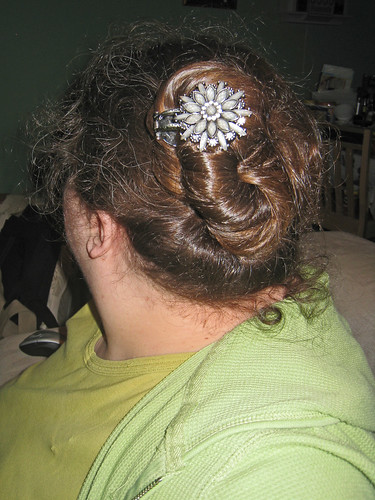
sparkly meI joined a friend for her monthly Ladies' Night Out, and enjoyed getting to know some great people.  There were some stories of dating, and how the single ladies could meet people.  The experiences that rose to my mind from my past were too risque for me to share on a first meeting. The stories began as one lady shared her recent experience of getting too many phone calls from an irate wife over a man she'd met who'd claimed to be divorced.  These are the hazards women must face when dating people they don't know.  We spent much time talking about how we married types could play matchmaker for our single friends.

Near the end my friend referred back to her calling herself a princess, but really, she thinks of herself as a queen, joking.  (I'd be happy to treat her as a queen.)  As I picked up my Red Tango purse with cat logo, I said "You wouldn't think so considering my purse and all my rhinestones, but I think of myself as butch, so not a princess."  Expressions of disbelief, of course.  I found myself reflecting on this.  Internally, I really don't see myself as feminine, and I had to think more about why that is.

Externally, I do sport some feminine things: rhinestone eyeglasses and pins; a small pink purse; skirts, never pants; long hair. It was even more difficult to defend my butch feeling last night, as the skirt I wore was not my usual plain denim, and my long hair was held up with a hair clip showcasing more rhinestones. There are other aspects about myself that are more butch, though, and while I think of the rhinestones as fun accessories, I think of my other more butch tendencies as more fundamental to me.

I am not much of a clothes fashionista.  I pretty much take what I can get, so this may be accidental karma. As a fat woman, I don't have much choice...though these days I have much more available than decades past.  I've never liked frilly, and it's pretty rare that I will choose a print over a solid color.  I think of my plain denim skirt as my "jeans."  I find it more comfortable and a better look for my body type than actual jeans, so I still think of my skirt as butch...that and my normal footwear are Ecco boots.  These were not in evidence last night, as my friend had invited us to "dress up" if we wished.  Instead, I wore my closest to dress up shoes, my trip-hazardly Danskos.  Oh, and I never wear makeup, nor a bra.

Those are the externals, but I find myself intrigued by what I think of as my internal feeling of being butch, despite my crow-like attraction to sparklies.  Aside from fashion, this is a larger question, of gender identity.  The men I like have high emotional intelligence, can keep up a meandering conversation, are around my height, no taller, are about as smart as me.  My sweetie is a bear type, of the dark-haired variety, certainly what I find attractive, but I also often find the androgynous look very attractive.  Among women, I find the feminine look attractive, but for me to admire, not to be. I communicate directly, don't do well with hints, or hint much myself.  I've never been interested in being supported, but to make my own way.  I could be wrong, but I think of these things as more butch than femme.

Some of my internal feeling cannot be separated from how I am responded to by others.  As a lifelong fat person,  I am rarely flirted with.  When there is sexual tension, or that rare flirting, I tend to be forward and direct.  Rather than getting or expecting to get the admiration, I am free with the compliments.  I'll let the queen know just how beauteous she is.

Maybe what it comes down to is at heart I find gender identity a construct.  When I unfold the layers, when I find me at the core, I just am.  Not feminine, not masculine.  And what is the default?  Masculine.  Which gender historically has choice, drive, independence, objectivity?  Masculine.  That's not really what makes one masculine or feminine, but that is what we inherit, and after digging, and finding my core identity to be about equal footing, I begin to see this is why I'd tip my identity more to the masculine side, and I begin to see how silly it is to try to pin down a true gender identity.  Maybe it's better to keep it a joke.  Of course I am a queen too! Do my bidding, good subjects.

Wednesday, June 22, 2011

On Movement, Mirrors, and Recognition

The Elegance of the HedgehogThe Elegance of the Hedgehog by Muriel Barbery

My rating: 4 of 5 stars

View all my reviews

Some books are made greater by discussion.  I wasn't too sure about how I felt about Elegance of the Hedgehog when I finished.  It reminded me of The Unbearable Lightness of Being, so my first thought was, is this a European thing?

Let me say I was immediately charmed by the philosophical analysis not usually expected of such characters.  Indeed, Madame Marcel appears to thrive on her secret internal existence.  Externally visible as a frumpy, dull concierge, in her private rooms she finds sustenance from the finer efforts of the human brain.

As it is not terribly common to come across a concierge waxing ecstatic over Death in Venice or to hear strains of Mahler wafting from her loge, I delved into my hard-earned conjugal savings and bought a second television set that I could operate in my hideaway. Thus, the television in the front room, guardian of my clandestine activities, could bleat away and I was no longer forced to listen to inane nonsense fit for the brain of a clam—I was in the back room, perfectly euphoric, my eyes filling with tears, in the miraculous presence of Art.
Her mirror, a 12 year old girl too wise for her own good (she plans to commit suicide, having already reduced her existence logically to a nihilistic existentialism), sees into the crafty concierge:
As for Madame Michel . . . how can we tell? She radiates intelligence. And yet she really makes an effort, like, you can tell she is doing everything she possibly can to act like a concierge and come across as stupid. ...Madame Michel has the elegance of the hedgehog: on the outside, she’s covered in quills, a real fortress, but my gut feeling is that on the inside, she has the same simple refinement as the hedgehog: a deceptively indolent little creature, fiercely solitary—and terribly elegant.
The best thing about this book are the amazingly insightful sentences.  Hey...I'm no slouch when it comes to the vocabulary, but I was checking the dictionary often (these are the times when one loves the Kindle).  Just check out this dig:
...enough of phenomenology: it is nothing more than the solitary, endless monologue of consciousness, a hard-core autism that no real cat would ever importune.
The cats are mostly related to Tolstoy, if their names are anything to go by.

The first thing mentioned at our book group was that we had to talk about the ending...but to get there we had to backtrack and figure out the characters.  Just what did being a hedgehog mean?  Let's review phenomenology, and how the understanding of it is affected by the haphazard studies of an autodidactic.  Let's make sure we understand the insight about movement and people as mirrors by Paloma, the 12 year old, who sees a hedgehog because she herself is one.  Finally, in one of those best moments of a book discussion group, as we're still trying to fulfill the Meaning of It All, I ask, a natural question in the flow of the conversation, I ask, "Is this book about Recognition?"  One of the others asks, "You mean of one character to another?"  "Not just that, but recognition with a capital R...recognition of movement, recognition of ritual, recognition of a hedgehog..."  This question was met with enthusiasm, so I think we got to the heart of it.

I didn't say, didn't need to, but I was also thinking of our Zen Buddist Recognition Ceremony.  There were definitely some Zen moments in this book.  The third main character, more mysterious as we don't get first-hand thoughts from him, was Japanese.  To me, this Recognition of the eternal nature of another, this is the essence of this book.  Once you get a handle on that, the mysteries sort of fall into place, and it becomes a much better book, rather than simply a cryptic one.

Saturday, June 11, 2011

My Talk on Sharing the Dharma

On the insistence of the other members of the planning committee, I was one of three people in the Discussion Panel at the Buddhist Festival in the Park, themed Sharing the Dharma. Given that I talked in part about sharing the Dharma with children, it's kind of appropriate that the only photo that I personally took that day was of the altar some girls arranged in the Children's Pavilion.  I'd given them an impromptu short lesson on how they could bring anything important to them to their own personal altar.

I didn't ad lib from my written speech, except when I apologized for my phone ringing.  This was of course embarrassing, as well as funny because I almost never set the phone to ring...only to vibrate...but this day I set it to ring, as it might be important if someone tried to reach me while we were setting up for the festival.  I am hardly ever in this position...at the front of an audience.  There were a few women in the audience who really made me glad to be there.  They were listening, and showing their appreciation with nods and smiles.  One woman in particular had such an encouraging smile that I had to go say hi afterward and thank her.  It made me realize that there is such a thing as a good audience member. When someone gives a talk, it goes both ways.


Here's my talk:

I want to talk about three aspects of Sharing the Dharma. We have many different Buddhist traditions here today, and each emphasizes a different aspect of the Dharma, perhaps even contradictory aspects, so I will talk a little about what we all share in common. Also, I want to talk about how we Buddhists tend to share the Dharma, without evangelizing, and I want to talk about sharing the Dharma with children.

People often ask me, “What makes you a Buddhist?” Even if we try to answer this, we will find different traditions have different promises you make. Most often called the precepts, these promises can range from 5 to 16, and many more for ordained monastics. How these precepts are treated can vary as well, ranging from personal guidelines, to somewhat rigid rules, to rules one commits to for a limited time. I have heard of some traditions where you commit to the precepts you’re sure you can keep.

However, there is one thing we share across traditions, across methods, whether lay or monastic, whatever country, and that is that we take refuge in the 3 jewels, Buddha, Dharma, and Sangha. I have managed to sound wise to my non-religious friends by saying that it seems to me these are 3 aspects you will find in any spiritual framework, if you think of the Buddha as the teacher, the Dharma as the teachings, and the Sangha as the community with which we share this refuge.

I take that back…even these will have differences. In some traditions, Sangha can only mean a community of 5 monks, whereas in others it can mean anyone or even anything you share a spiritual refuge with. Some people find their refuge in the community of mountains, trees, rocks, and streams, and in my Zen tradition we would say those mountains, trees, rocks, and streams are sangha to those folks.

Still, in the traditional sense, we find refuge in the historical Buddha, in the Dharma teachings that have flowed forth from that Buddha, and the Sangha community that has supported this flow down through the ages. We find this triple jewel to be our spiritual home.

Many of us who have converted to Buddhism come to it in part because it is a religion that for the most part doesn’t try to convert you. In some cases, we like it because it seems not to be a religion, as we don’t worship a god. For the most part, we want it to be a choice, freely made. In my experience in Zen, we might even say, “Don’t do this for this or that reason.” We might say, “Don’t start unless you are prepared to take this on for life.” In many cases, we do this because we must. An eternal question has made itself felt in our lives, and Buddhism seems to have the tools to respond to it. Then, we Buddhists won’t say, “Have faith. Believe.” Instead, we will say, “OK, give it a try. Your experience will show you this is the right path.” This is our faith. We are ok with somewhat different paths pointing to a universal experience.

This eternal question is the manifestation of the 4 Noble Truths, another piece of the Dharma we all share. We seek out this path because something about our life is unsatisfactory. Truth number 1: Life is marked by dukkha, or suffering, or unsatisfactoriness. Truth number 2: We’re not talking about the simple pain of broken bones or a sore throat, we’re talking about that extra grasping we do. We don’t just feel the pain, we really want that pain to GO AWAY. We’re talking about the clinging, the grasping we do to have life be a certain way. This is how life is…seems like a bad thing…but without this grasping, would we seek out an answer to that eternal question? Would we seek a way out?

That brings us to Truth number 3: There is indeed a way out of this grasping and craving. Here is where you find our Buddhist faith. We trust those who have gone before, the Buddha, those teachers who have said, yes, I’ve been through this, and I’ve experienced this way out. Still, we say, “Find out for yourself.”

Finally, those buddhas who have gone before tell us this is the way out: truth number 4: The Eightfold Path.

Different traditions may focus on different aspects of the Eightfold Path, but we all agree this is a template for a path out of suffering. Some paths may emphasize a sudden realization, some a long slow integration, but however we understand it, we find the Eightfold Path integrated into various aspects of our teachings. [[Wisdom: 1. Right View 2. Right Intention Ethical Conduct: 3. Right Speech 4. Right Action 5. Right Livelihood. Mental Development: 6. Right Effort 7. Right Mindfulness 8. Right Concentration]]

Woven through all those “Rights” in the eightfold path is an understanding of the Middle Way. What does “Right” mean for you? The Buddha found his Middle Way between the comforts of a prince and the deprivations of an asthetic. What is the “Right” way for us to live in this modern world? Again, our different traditions will have a different response to this. Even within our respective communities, we will have different teachers who have different styles of response. Without a casual response, with thoughtfulness, we each will have a Middle Way, and we each will have a choice. With each moment, we have the opportunity to find the Right response, this is the path we keep choosing, this choosing is the way out of the dissatisfactoriness.

I have noticed over the years that converts are particularly enthusiastic about sharing their religion. During the early years, I learned that in my enthusiasm I could tell a person much more than she really wanted to hear. A polite question about my religion of choice did not mean a person wanted to know about the basic teachings, or go to a workshop on how to meditate. I learned to respond to the specific question, and offer no more. If someone really wanted to know, a conversation would begin.

I loved that I could make this choice, and I remembered my childhood in which I did not have a choice. Ironically, I was allowed to stop going to my United Methodist church only after my “confirmation.” After I was confirmed, I kept going to church after all, and I now realize that I stayed because I found refuge in the community, and because the community accepted me, I accepted the teachings. Later, as I uncovered my own notions of what I believed, I realized I had not been given a choice as a child. I had been coerced. I had been taught religious opinions as though they were facts and laws of nature as tangible as stones and erosion. As I now was able to make this choice, so I now felt it was so very important that each person be allowed to make their own choices. I cringed at the documentary “Devil’s Playground.” What choice do these Amish teens have, when set loose at 16 to experience the world, when they have been taught from babies that if they do not choose their church, they will go to hell?

Now you find me here, helping people to find this refuge. You find me teaching children about the Dharma, for over a dozen years now. I tread lightly. There is much in the teachings that can be shaped for children, but I treat myths and legends as myths and legends. I say “Some people say” or “some find it useful to understand it this way.” Even with 5 year olds, this works. They, more than all of us, understand story. They live story. They accept story as real, whether we say it’s a story or not. When they get older, with the skepticism of a growing brain, they won’t look back and think, “it’s all untrue” because from the very beginning we gave them the choice.

For example, for children’s Jukai, or taking of the precepts, we use the 3 refuges and 2 promises from Thich Nhat Hanh’s tradition, and we tell the kids, “This is a promise that is only for this year. Next year you can take the promises again. If you don’t feel like making these promises is something for you, you don’t have to, you can keep silent. You can wait til next year.” Some kids do just that. Still, we can’t avoid all coercion. When it is a child’s first year at Jukai, they get to choose a mala, and it’s no surprise, most want that mala made for kids. Enticements may be a form of coercion, but it’s a pretty mild form.


So on the one hand choice is important, on the other hand, it is the nature of kids, and all humans, to have a deep need for shared stories and connection through ritual, and well, tangible stuff. Through the shelter of Buddha, Dharma, and Sangha, we find these needs met. Most important of these needs, I think, is kind attention and acceptance. Through this path, through the original need that came from dissatisfaction, if we can embrace a self-acceptance so complete, so profound that this self doesn’t matter, then all selves matter. Then the Right paths can happen not because we make an effort, but because the rightness falls into place because it is not for this self, but for all selves, that we tread this path.
Friday, June 10, 2011

Obsessions vs. Goals


Books read January 2009 to May 31, 2009 (pre-Kindle): 25
Books read January 2011 to May 31, 2011: 71

The Kindle hasn't just re-ignited my love of reading books.  It's made me obsessed. (Now as low as $114 new.)

Latest obsession:  Rachel Caine.  I began reading her Morganville Vampires series on May 5th.  I finished with her latest, #10, on May 19.  Now I've begun her Weather Warden series.

Other obsessions: Charlaine Harris...her other-than-Sookie-Stackhouse books; Cate Tiernan (I actually had to Inter-Library Loan a book from her Balefire series, the only one that wasn't available on the Kindle); and um...paranormal erotica.  mmmm werewolves.  The only time growly males in romances are interesting.

Kindle cover pictured was a Christmas present to me from my sweetie's other sweetie. She commissioned it from an Etsy seller.

There's that, and then it seems my obsession over books leaked over into TV obsessions.  My sweetie bought us a new TV and Tivo with the new year, and along with that we finally subscribed to Netflix, streaming only.  If I started watching a TV show that interested me, I watched and watched until all caught up. This happened with Monarch of the Glen;  the Doctor Whoniverse; Jekyll (seeing a pattern here?); and Gossip Girl (library DVDs).

Total fluff, total fun.  Not really conducive to writing.

I want to set up some goals, and I hope you, dear readers (if I have any left), can help me to keep on task.

  1. I'll write at least one post here a week.  More would be better, but would be hindered by number 2, below.  Readers' task: leave a comment about those kinds of posts you've liked best.  When I sputtered to a crawling stop, I'd kind of devolved into mostly book-blogging, and I want to get back to the Multiplicity that this blog is all about.
  2. I'll catch up on my Dharma School blogging before we start teaching again in September.  I've been postponing for 2 1/2 years.  That's somewhere around 20 lessons to write up. Approximately two a week, here we go!  Unfortunately, with some of these, I won't have the fun details that came up in the lessons...but then, that means I should be able to write them quickly.
  3. At the very least I'll blog about the books I read for a book group.  For now that's one per month. Starting in the fall we'll have our Classics book group, so then it will often be two per month.  Unfortunately, the Classics Pageturners is on the third Sunday of each month, and my regular Pageturners is on the third Tuesday of the month.  Here again is where the Kindle comes in handy...very easy to review passages I've highlighted.  I'll have to schedule my book-reading. Maybe I'll do a slow-read series once in a while again.
  4. Pick up that novel-in-progress again, and write it.  I think someone needs to set me up in a hermit's cabin with electricity but NO INTERWEBS.

Thursday, March 17, 2011

On Zen Teachers and Students Part 2

Eric Storlie mentioned in his piece that Eido Shimano Roshi's behavior was known, and documented in Robert Aitken Roshi's papers which surfaced after his death.  Storlie says

In forty-six years of Zen practice I’ve observed Asian (and now Western) swamis, tulkus, roshis, rishis, dharma heirs, lineage holders, and masters of various stripes, as well as their disciples, explain that the master’s fiscal extravagance, alcoholism, cruelty, sex addiction, violence, and even rape is – of all things – "a teaching!"
Perhaps. Certainly the Age of Aquarius is marked by sexism in the guise of sexual freedom. I wonder if he judges the present based on his experience decades ago.  I also wonder if it is more ambiguous, as I think about how to write a document that says, "Take care."  I have contact with many leaders in my area, and I respect many of them.  Some I have reservations about.  I know for a fact that one did have an affair with a student. (I did not have reservations about him.)  I suspect another who has other obvious issues with sexism, not to mention authority, and simple courtesy.  The problem is not Transmission, but this Wild West infancy of American Buddhism.  Anyone can hang up a shingle and call themselves a professional priest.  Most people encountering Buddhism won't know anything about certifications and qualifications.

What I have to be concerned about is more subtle.  People seeking a new spiritual direction encounter kind and generous people, and they also encounter predatory people.  Myoan Grace Schireson's husband Kuzan Peter Schireson penned a comprehensive article on this that went along with my thinking: it's not just about sex, it's complex, and it can include vulnerability to cults.  He makes several points, drawing on the International Cultic Association website What is often considered good medicine in Buddhism can easily turn bad: respect for the teacher turning into unquestioning subservience; or letting go and leaving home turning into isolation and loss of autonomy.

Peter said, and I'd been thinking along these lines:
What I’m suggesting is that it might be useful to consider every spiritual community, every Zen sangha, as a cult risk. Human tendencies in this direction are strong. Societies and groups develop hierarchical structures and the impulse to endow leaders with special traits and powers seems hard to resist, arising from deep socio-biological roots. And these impulses are especially dangerous when a leader himself (or herself) – often an ambitious person despite other good intentions – is pulling for adulation and power.
I'd say these impulses are so strong even when a teacher isn't pulling for adulation and power, the students give it to them, and especially because they are good people, and modest, such teachers don't realize how isolated they themselves are in their opinions and views, because few disagree with them.

Later, Myoan Grace Schireson added a vital piece to the discussion.
So to study this problem. I propose we consider all three levels: personal, interpersonal and transpersonal. We cannot just say that these problems occur because of “bad actors” or sociopathic teachers– there are far too many similar situations to call these problems anomalous. We need to carefully study how all parts work together to intoxicate the Zen sangha and to enable a misguided teacher to harm its members. This is not about blaming teachers, but it is about making sanghas safer for practitioners through education and self-reflection—both outstanding attributes of Buddhist practice.
Things don't always start out this way, but thanks to the heady dynamics of spiritual intimacy, this pattern can easily happen.

In my own experience, and in those I have witnessed, I must say Myoan's third category to examine, the transpersonal or spiritual level, is very important.  This Buddhist practice of meditation and examination opens up areas of our beings long held constrained.  It is quite natural as barriers and boundaries dissolve, to feel love arise.  I suspect perhaps this may very often first manifest as falling in love in someone in particular.  It is compelling.  It would be difficult to turn away from, to say no to.  Such a connection feels too Big to ignore or wait for, yet if a love cannot go through a reasonable waiting period while such conditions of teacher and student are dissolved, perhaps it is not Big enough to be a lasting love.  In ordinary cases it arises between peers, and it is almost becoming a standard form in my community for young ordained to take time off from monk training to develop a newly found love interest.

Myoan says
It is not difficult to mistake spiritual energy for sexual energy, physical attraction or even human love. In fact, spiritual energy may be one of the bases for human attraction. We may not in fact be able to truly distinguish the differences between these energies, but the fact of their (simultaneous) existence needs to be clearly understood.
 I would go so far as to say, why separate them?  This cosmic goop of interconnection is what love comes from, what spiritual uplifting comes from, indeed what attraction comes from.  My teacher has often said that even the most heinous acts, such as murder, arise from this wish for not-two.  But, simple as the love impulse may be, repercussions (aka karma) are complex, thus the ethical rules.

I could see how a priest or other clergy leader could experience this once, discover the powerfully heady emotions, and seek it again and again, soaking up the excitement and the power.  I could see also how, because rules say it is wrong, and because we as repressed Americans are already poorly equipped to manage sexual feelings, that a clergy leader could be caught in this trap in spite of themselves, because they only have (poor) tools for abstention, not tools for management of these feelings.

So....
  1. Legitimacy
  2. Guidelines on boundaries
  3. How to recognize cult-like dynamics
  4. How to understand personal and interpersonal dynamics of the spiritual quest
These are the things I need to list and hone.

Oh!  How did I get this far and not mention my own community's ethics document? I'm sure I've got some specifics I can glean from there.

Tuesday, March 15, 2011

On Zen Teacher and Student Behavior

This first quarter of this year has been marked by teacher/student sex scandals in the Zen world.  I've been following Sweeping Zen on Facebook, and at least a dozen responses to these events from various American teachers have appeared there. For a couple of years I've intended to create a document for the Buddhist Festival in the Park that would say that a group's participation at the festival does not necessarily mean an endorsement by the Buddhist Peace Fellowship, and here are some warning signs, etc.  Considering this is on the minds of folks in the Buddhist world, it's about time I followed through with this intent.  I'm sure I'll have plenty of material to glean from these many articles, including some from psychologists who are also teachers.

For now, I'm going to try to collect my thoughts, so this may take several posts.

One person's response is to do away with Dharma Transmission.  Here was my response at the time:

I think Storlie mistakes the form for human nature. It doesn't matter what form it takes, human nature will bring about problems with power, authority, and institutional practices. The fairy tale is not dharma transmission, the fairy tale... is the archetypal transmission of power we humans give others. Take away dharma transmission, and we will insist on filling the void with new corruptible practices. Whether a 10 year institution, or a 1,000 year institution, diligence will always be required against this tendency to corrupt veneration and trust, no matter how pure the intent. Plus, no matter how you try to clear the slate, karma will still remain. Horrific things have been done while trying to ignore this. The Protestant Reformation quickly corrupted. Erase the tsars, create new despots among all the communist equals. Does it help or hurt for those of less corruptible intent to boycott the institutions? Personally I think it hurts more when something is erased and the void is left to be filled by ignorance. There are plenty of charlatans out there who refuse the institution of dharma transmission for their own gain.
A couple of days later, a Zen teacher and psychologist responded with an argument quite similar to mine. (Hmmm...yes...it is quite likely she saw my post...glad I could help.)

Aside from the question of sex with teachers, there is the question of legitimacy, and power and authority that needs to be addressed.  This is a huge topic, a morass of spiritual aspiration, heart entanglement, psychology, and ethical guidelines that attempt to put harnesses on this mixture of lofty and base predilections of this human animal. 

I guess what has triggered my procrastination pattern is this entangled morass, but in the end I suppose all I, and we who present the Buddhist Festival, is give some of the same old ethical guidelines, and point to them when it comes to light that someone has been violated.

So far:

  1. I wish to address the issue of legitimacy.  How do you, a potential Buddhist practitioner, decide on the credentials of the person you look on as a teacher?  There are teachers who do not come from a line of Dharma Transmission.  There are teachers who have ethical and/or psychological training.  There are teachers who have been judged to have a spiritual understanding that enables them to guide you on this path of enlightenment. How do you judge these things?
  2. Regardless of credentials, teachers will be human, and will transgress boundaries.  Guidelines regarding these boundaries need to be listed.